
BY ROBYN PARKES
In February 1915, Turkish forces in the Middle East attempted to breach British defences on the strategically vital Suez Canal. Seizing it would cut British communications with East Africa, India and Asia, and prevent British Empire troops from reaching the Mediterranean and Europe.
Turkish forces began an assault to take the Suez Canal in early February but were repelled with heavy bombardment and losses. It was in this battle that the 12th Nelson Company of the Expeditionary Force experienced their first taste of war and played a significant role in the skirmish. Unfortunately, a young Private Ham of Motueka was killed in the battle.
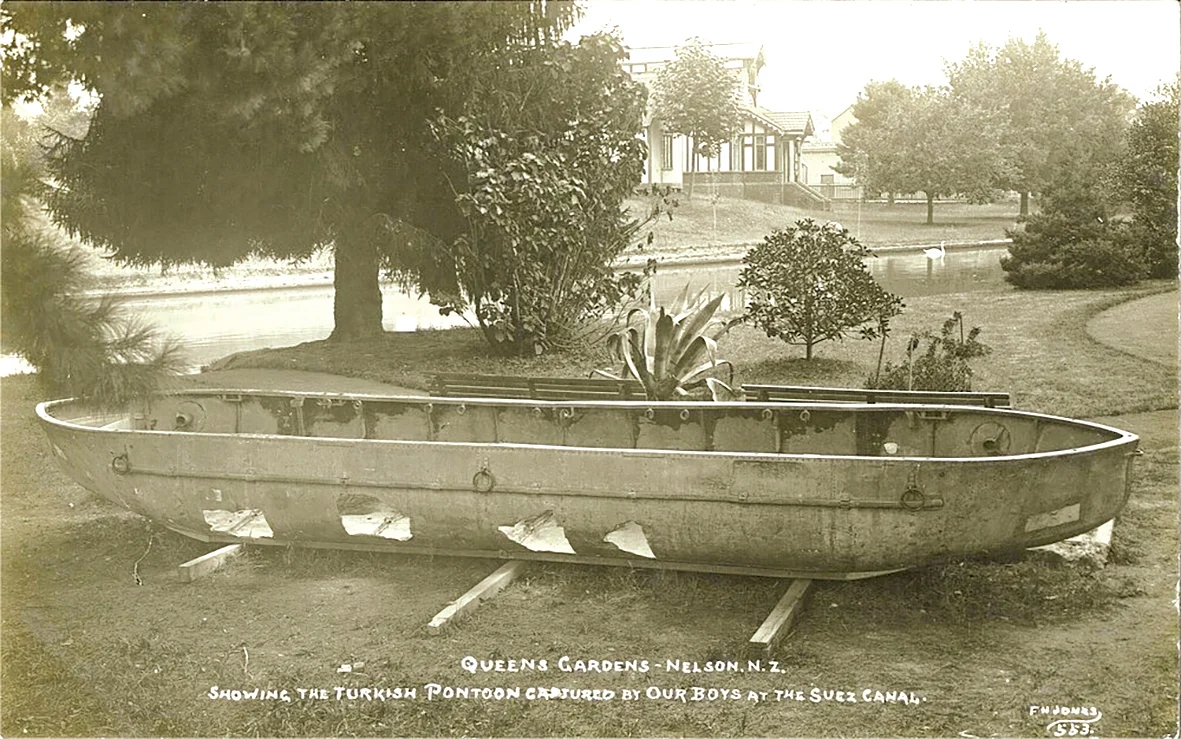
It was from the skirmish that a Turkish pontoon was captured and ultimately transported to New Zealand as a war souvenir. The pontoon weighed around 1.5 ton, was made of thin iron, galvanised with timber runners and was 25ft in length, 5ft beam and around 3ft depth and was bullet ridden with three of four jagged holes, made from shells.
With the connection to Nelson soldiers the Government decided to gift it to the city provided that its care and preservation was ensured.
After its arrival in Nelson it was for a time kept in safe keeping at the gasworks before finding a more permanent home.
However, reports in November 1915 stated that the pontoon had been seen not far from the rubbish tip, this considered to be disgraceful considering its significance.
The Council quickly refuted the claim, but a concerned resident took photographs of its location, sitting beside notices about dumping of rubbish in the rubbish tip.
Action was taken and the pontoon was placed in Queens Gardens.
In 1916, concerns arose that souvenir hunters were taking pieces off the pontoon so it was suggested that it should be mounted on concrete blocks and enclosed so that the public could not tamper with it, and further, that a cast-iron plate bearing an inscription showing how it was captured by the Nelson Company at the Suez Canal be placed nearby. The realisation of an engraved inscription plate at the cost of £7. 10s, took another two years.
For many years the pontoon sat in the gardens where visitors and the people could visit it and reflect on its significance, but the call for its disposal began in early 1942.
Also on display on the grounds of the art gallery was a captured German field gun. Bishop Suter of the Art Gallery Trust requested the gun be removed as the children were using it as a siege place with some defending and some attacking, resulting in multiple windows being broken. Suggestions for its disposal were to either melt it down or to sink it in the bay.
It was resolved that the question of both objects should be considered by the Reserves committee and that the thoughts of the RSA be considered. The gun was removed two years later and taken to the Works Depot, pending a decision on its final disposal. The pontoon was removed in 1952 and was relocated to the front of the RSA Hall.
