
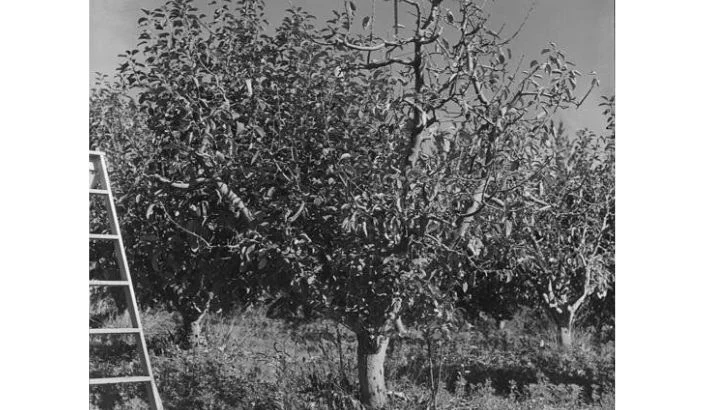
In April 1900 the Government was considering the idea of establishing an experimental orchard in the Nelson district, but it was not until 1930 that this was achieved.
Fruitgrowers were eager for this to happen with a need for research to solve various issues. In particular was the problem of cool storage and the temperatures that fruit should be held at while in transport to eliminate the wastage of fruit.
Orchardists wanted to learn everything they could about the soils in the district, how to improve poor soil to increase economic value.
In July 1930, the Hon. Mr Atmore informed the district that the experiment orchard would be in the Appleby district for which cabinet was prepared to make a grant. The identified land consisted of 29 acres, 20 of which were planted in an established orchard suitable to the needs of the research authorities, and an adjoining 43 acres of virgin land.
The Empire Marketing Board offered a grant of £2000 towards capital expenditure and £1500 per annum for maintenance for five years. The Cabinet grant was £810 plus £1500 for four years. The land cost £2250 for which the Fruit Growers Executive agreed to donate £1250. The property was vested in the Scientific and Industrial Research Department.
The land was on what was known as the Stewart Estate on the Appleby-Tasman Road. An established orchard of 2400 trees would be available for instructional work, worked by experts in horticulture and by scientists, and the virgin ground would be devoted to experimental work to ensure the development of the fruit industry. Mr J H Thorp was appointed as the first orchard manager.
Other plans involved the Horticulture Division of the Department of Agriculture and Cawthron Institute extending their field investigations, the Fruit Research Committee undertaking a scheme of investigation on tree stocks, the influence of fertilizers and lime, pruning, insect and fungoid investigation, the influence of transport and storage under known temperature and humidity, and future cool storage options.
Manurial experiments began to ascertain the precise effect of plant food constituents on the trees. Although potash, sulphate and nitrogen classes of manure had been used for many years there was still ignorance about the effect of the manurial constituents of the fertiliser. Studies also began on the general health of the trees, on the incidence of disease, fungus, insect pests and physiological diseases.
Soon experiments were underway in comparing unsprayed trees to sprayed trees, the addition of sulphate of iron in small quantities to lime sulphur solution, and mapping out for the control of red mite.
In 1932, investigations and trials began on the adoption of corrugated cardboard linings in ordinary fruit cases to reduce the amount of damage due to bruising. By 1934 the grant from the Empire Marketing Board was discontinued, so to raise money to continue the work, the Orchard Tax was proposed to be increased from 1 shilling to 2 shillings per acre, bringing in around £1000.
The acquisition of the orchard proved to be of vital importance for the district and improvements were made in multiple areas. Effective manurial programmes were developed to improve the land of orchards. Magnesium and boron deficiencies were successfully overcome, control of insect pests, management of diseases and addressing the problems of cool storage were all addressed and improved on to ensure the district remained to be a major producer and exporter of fruit.
