
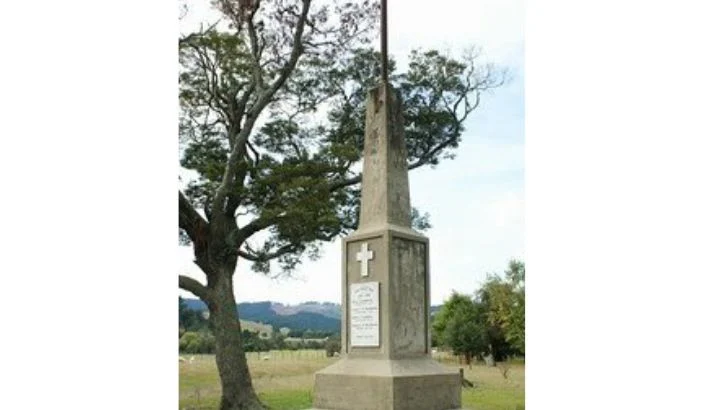
On a cold morning on the 15 January, 1920, the foundation stone of the Stanley Brook war memorial was laid by the Rev. O. Hewlett of Auckland, who was previously the Vicar of Wakefield, in which parochial district Stanley Brook used to be.
Reflection and thanks for the men who gave their lives for freedom was given.
The president of Stanley Brook Farmers’ Union (Mr Fenemor) then presented to the Reverend the trowel with which to lay the stone.
As it was laid the following words were used: “To the glory of God, and the blessed memory of the gallant dead, we place this foundation stone in the name of God the Father, God the son and God the Holy Ghost Amen.”
After the address the hymn “For all the saints who from their labours rest” was sung and Rev. Mr Hewlett then pronounced the Benediction. The ceremony ended with the singing of the National Anthem.
The monument, built on a small terrace in the school playground, consisted of a tablet and cross of Italian marble inserted in an obelisk of concrete, with a sub-base of the same material and base of Wangapeka granite, 10 feet square, surmounted with an iron flagstaff—in all 40ft 6in high.
It was designed by Mr H. Faulkner, and labour was provided by the settlers who erected it under the supervision of Miller and Sons, Nelson.
The names of four local men were placed on a tablet:
Frank T. F. Drummond - killed 7 June 1917
Edwin J. Fenemor - killed 1 September 1918
Russell B. Macmahon – died 22 November 1918
John J. Crompton - killed 1 October 1917
The unveiling of the completed monument took place on 21 October, 1920, and was observed as a holiday in Stanley Brook.
About two hundred people assembled in the school grounds at noon.
The Defence Department was represented by Lieut. Sugdon, and Captain Harley represented the Returned Soldiers’ Association. South African war veterans and returned soldiers were distinguished by their ribands and badges.
The next-of-kin of the four boys occupied a front seat and the school pupils lined up at the base of the monument —each holding a wreath of flowers.
The service was opened with a hymn and Archdeacon Kempthorne read the lesson followed by the Bishop of Nelson reading the prayer.
Captain Harley addressed the assembly, and in a stirring speech expressing sympathy with the bereaved and delivered a message from comrades-in-arms.
Mr H. Faulkner assisted in unveiling the Memorial Tablet, and the Bishop further addressed the school boys and girls, explaining the Union Jack, which he said symbolised liberty and unity.
The Bishop then announced that the flag would be flown over the monument in future on the following days every year:—On the anniversary days of the death of the boys of Stanley Brook School who died in the Great War, on St. David’s Day, 1 March; St. Patrick’s Day, 17 March; St. George’s Day 23 April; Anzac Day, 25 April; Empire Day, 24 May; King’s Birthday 6 June; Prince of Wales’ Birthday, 23 June and St. Andrew’s Day, 30 November.
The school pupils then placed their wreaths on the base and relatives and friends of the deceased soldiers added floral tributes to the monument.
