
BY ROBYN PARKES
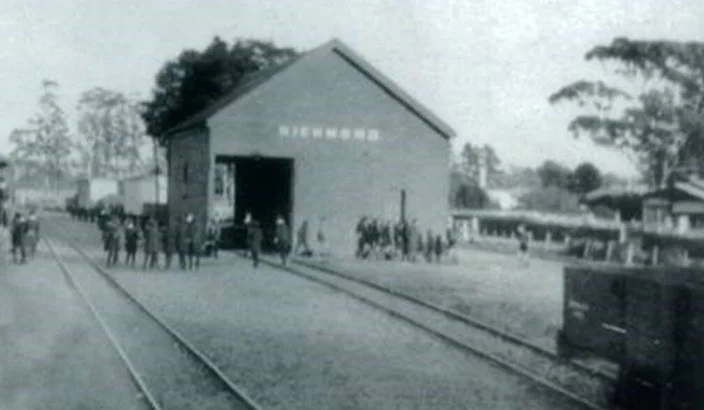
Richmond’s single-platform, wooden railway station, along with the Post and Telegraph office, was opened on January 29, 1876, forming part of the Nelson to Foxhill line.
The station was well placed with a short walk into the town but also giving easy access to Richmond Park where so many events occurred throughout the year.
Stationmaster Mr Petrie’s life was a busy one with seemingly regular incidents occurring. In February 1878, a spark from an engine ignited the dry grass in the station grounds.
It had a good hold before being discovered but Petrie, along with Messrs Canning and Hodder, was quick to douse the fire before more damage could be done. In September of the same year, the coach from Motueka drew up at the station and the driver, William Burrell, after turning his horses towards the roadway, asked a passenger to stand at the head of the leader while he delivered the mail.
Burrell was about to return to remount the coach and was in the act of gathering the reins when the horses bolted. The passenger was knocked down and trampled on and the driver was pulled under their hoofs. Both were injured with one taken to hospital.
After 31 years of service, Petrie retired in late 1903 and was replaced by his son, James P Petrie.
In 1904, there were further incidents with two causing injuries. In May, one the horses of the Motueka coach reared, kicking the driver as he was climbing onto the coach, causing him to fall. The horses bolting with four ladies inside the coach whose screams further frightened the horses. A few months later another coach capsized in the station yard while turning. Several of the passengers and the driver were left with cuts and bruises.
A third incident occurred on Boxing Day when an elderly man alighted from the western side and attempted to cross between the carriages to the other side. Just as the train moved off, Jacob Berryman was able to grab him.
James Petrie was transferred in November 1905 to Masterton to take the position of chief clerk. His replacement was J. Henderson, who had been the stationmaster at Motupiko. Henderson spent around five years as stationmaster before leaving in August 1910, when he was promoted to Dunedin.
With ‘economy and efficiency’ as a driving force, railway manager Mr Thomas Edwards informed the Richmond people that the position was to be left vacant until it could be proved that traffic had increased. With no stationmaster available, complaints began about the inadequacies of the station.
In May 1912, the Hon. R McKenzie visited the region and Richmond’s Mayor took the opportunity to raise the matter of requiring a stationmaster. If the position could not be reinstated it was asked if there could at least be a porter to look after the goods as it was not uncommon for goods either be lost or taken through a lack of supervision. McKenzie stated that as Richmond had a new Post Office and it was no longer at the station, the stationmaster’s position was not needed, but he did agree to pass the matter onto the Minister for Railways.
By September nothing had changed, but protests continued so, in 1913, as a compromise, a porter-in-charge was hired.
By 1930, the viability of the railway itself was being considered. Under the retrenchment scheme Richmond was reduced from a tablet station to a flag station, which meant that the porter position was ended. A meeting was held a short time after with a representative of the Railway Department to try to reverse their decision, to no avail.
Efforts were made to increase the volume of railway business and lessen the cost of delivery. Sadly, with improvements to the local highways, traffic through Richmond station was gradually lost, and in 1955 the railway closed.
