
BY ROBYN PARKES
Phoenix, Louisa Campbell, Laura, Pilot, Star of the South, Rifleman, Meteor, Maid of Erin, William, Mary, City of Nelson, Deesse, Wallaby, Juno, and E U Cameron were boats and ships that either ran ashore, were completely beached or were wrecked on Farewell Spit between 1866 and 1870.
With the Spit causing a good deal of trouble for vessels, a grievance was lodged in 1866 on the prolonged delay in the building of a lighthouse there. As each vessel grounded, there was a call that enough was enough, and it was imperative that a lighthouse be erected.
The Government obtained the services of Richard Aylmer to oversee the need for lighthouses in the colony, including one at the Spit. Aylmer felt there was nowhere on the Spit giving sufficient elevation where a lighthouse could be constructed and that the sandhills constantly moved.
He felt the best option was to use a lightship, (a floating light) at the Spit end, where there was shelter for one to ride in safety and would be visible from the deck of a ship at a distance of about 12 miles.
James Balfour, marine engineer of Nelson, felt that a lightship would be a mistake, less efficient and more costly.
Divided opinions, cost factors and the pros and cons of lightship vs lighthouse continued, however in October 1868, 600 acres of land was reserved at the extremity of Farewell Spit as the site for a lighthouse.
Tenders were invited in April 1869 for the erection of a timber lighthouse, with Samuel Brown successful with a tender of £2496, with work to be executed in 30 weeks’ time. Mr Hales, a provincial engineer, was appointed to oversee the building.
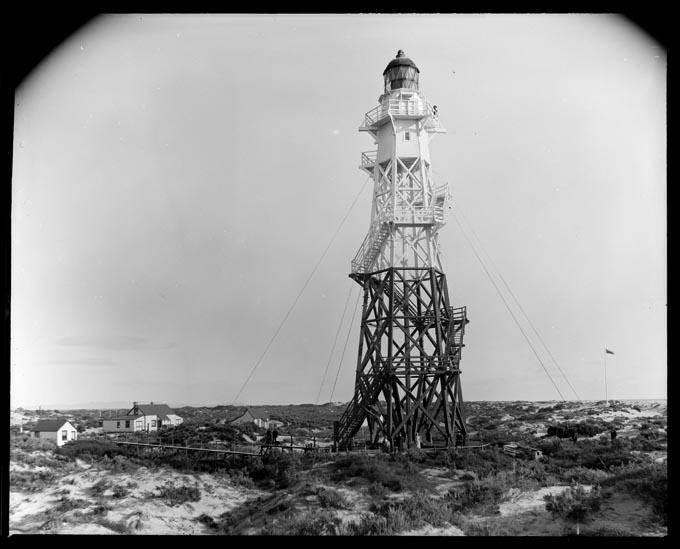
On the 19 May, Balfour and party landed at Collingwood and proceeded to the Spit to peg off the sites for the tower and other dwellings. The completed structure stood on a slight hillock of sand at Bush End Point and was about 118 feet in height from the level of the sea. The tower was a new design, some 100 feet in height and 40 feet in diameter at the base, the lantern adding about 15 feet more to its altitude.
The main structure was hexagonal and was quite open and unboarded, up to 80 feet from the ground, the remainder planked and caulked to form lamp and oil rooms. The lantern was reached by a staircase outside the framework and winding around it to the top of the tower in flights alternated by landings. The timber used was Hobart Town blue gum, cut to the requisite dimensions before arriving at the site.
The building was fitted together on the level at the sandspit before raising. The painting was overseen by Mr, Louisson, the different storeys being coloured red and white alternately, for the purpose of making it visible in foggy weather. The lantern apparatus, made by Messrs Dove and Co of England, was put in by Mr. S. Wakeford.
At a short distance from the tower, dwellings and storerooms were built for two families.
By 1891, the lighthouse needed to be replaced as the timber was in bad shape. The decision was made to build it of wrought iron. Messrs Anderson of Christchurch won the tender for the iron at a cost of £828.6sh.
The new lighthouse was built 176ft eastward of the old one and was completed by November 1896, having taken three months to build. The existing light was reused, being elevated 97ft above sea level and allowing 15ft for the height of the observer’s eye was visible 15 nautical miles in clear weather.
