
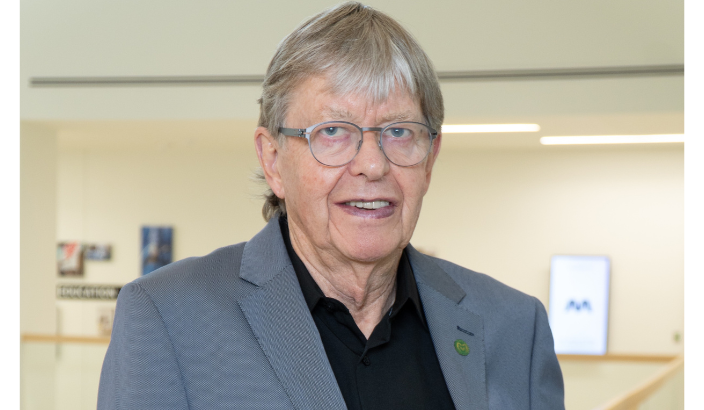
Five Nelson Tasman locals have been awarded 2025 New Years Honours. Throughout Tuesday, Nelson App shares each of their stories.
Kaiteriteri and Colorado-based Professor Wayne McIlwraith is globally respected in veterinary medicine and the equine industry.
He has been made an Officer of the New Zealand Order of Merit in the 2025 New Year Honours for his tenacity in the specialities predominantly in the USA, but has still retained good stead within the field in his country of birth.
“It was a surprise of course, but I'm appreciative, particularly because veterinary medicine doesn't get as much profile, it’s good to see work in that area recognised,” he says.
Oamaru raised Wayne hit his stride in equine veterinary surgery when he trotted overseas after a stint practising in Darfield after gaining a veterinary degree from Massey University in 1970.
He obtained higher qualifications from Purdue University in Indiana and became a member of Colorado State University’s (CSU) veterinary medicine faculty in 1979 and went on to hold multiple roles conducting equine and human joint disease research.
He recently retired from the university but remains present.
One of his many plaudits was pioneering the use of arthroscopic surgery in horses in his early years at CSU after reading about diagnostic arthroscopy on human knees as a resident and graduate student of Purdue.
It’s now used worldwide as a minimally invasive surgical technique to accurately explore and treat issues in any joints in horses.
“Arthroscopy started as a diagnostic technique where, before that, oftentimes the joint was cut open and a meniscus was removed when you didn't know the state of damage or whether it needed to be removed,” he says.
“Arthroscopy enables putting the scope in the joint, the first one I had was only two millimetres in diameter… and through a stab incision in the joint and blowing it up, then you could make sure that you did indeed have a meniscal tear or cartilage flap or piece of bone.
“By the time I went to Colorado in 1979 I was starting to do surgery under arthroscopic visualisation and the rest is history.”
Wayne says the technique initially drew scepticism from the equine industry, but it became admired after a horse had a bone chip removed in 1984 at Miami and won the Kentucky Derby by six lengths five months post-surgery.
He says many examples of the surgery’s success have since ensued.
In his CSU tenure, Wayne founded the Gail Holmes Orthopaedic Research Centre in 1994 which investigates the pathogenesis, diagnosis, treatment, and prevention of neuro-musculoskeletal disease and injury for the advancement of animals and humans.
He also opened the C. Wayne McIlwraith Translational Medicine Institute in 2019, a high-tech hub bringing together scholars, creators, and entrepreneurs to discover and deliver solutions that utilise the body’s healing capacity and improve the lives of animals and their careers.
Wayne says some of his experience at the centre and institute had been brought to New Zealand’s equine industry through his posts as a Massey University adjunct professor and chair of the New Zealand Equine Trust Foundation Board.
“We're still working on a safety centre for early diagnosis or early prediction of injuries, and we hope to establish the centre in Waikato’s Cambridge area,” he says.
“That will be a leader in early prediction of catastrophic fractures and other musculoskeletal injuries.
"It's particularly critical that we have optimal welfare for the equine athlete… we're getting better, and the rate of injury is quite low in New Zealand compared to some other countries.
“But we want to make it as close to perfect as we can.”
Wayne has authored seven textbooks, more than 500 scientific publications and textbook chapters, and delivered more than 700 presentations, seminars and workshops internationally.
He has received numerous gongs, including induction into the International Equine Research Hall of Fame, and five honorary doctorates from international universities.
Wayne is also a New Zealand Equine Veterinary Association life member.
Since retiring from surgical practice in Southern California in 2023, Wayne plans to visit New Zealand more often, including to the Kaiteriteri property he’s divided his time between for the past 15 years.
Wayne also won’t enable his stable career to fall back, and will continue to be involved in supporting horses’ welfare.
