
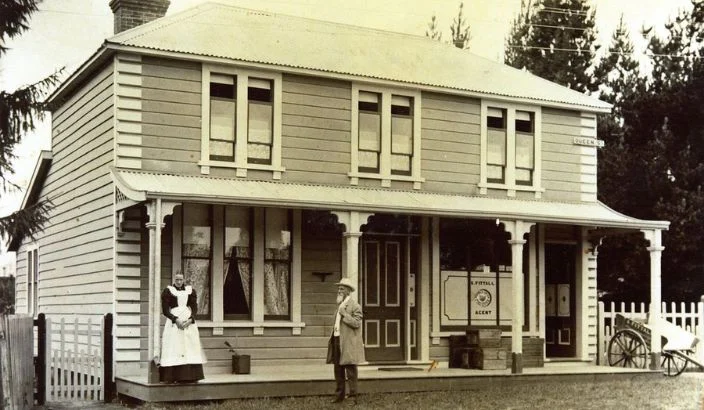
Samuel Fittall, a highly-respected resident of Richmond was born in London, in 1837, the fourth son of Stephen Fittall.
After completing his education in England, Samuel worked for the Gutta Percha Company of London.
At the time Samuel worked there, the company was connected with the construction of using rubber as an ideal insulator for submarine telegraph cables.
Samuel left England, sailing to New Zealand in 1858 aboard the ship Montmorency and disembarked at Wellington. One of his first jobs was in Hawkes Bay, painting and papering what was known as the great Separation Room in Napier, afterwards used by the first Provincial Council of Hawkes Bay when the district separated from Wellington.
Samuel then moved to Nelson and married Ellen Maria Hooper, daughter of Edwin Hooper, in 1868 and the couple had seven children.
By 1881 they were living in Richmond, at which time Samuel was an overseer of roads and works for the Richmond, Hope and Stoke area.
He appears to have been a progressive with a focus towards the future of the Richmond settlement, and was involved in securing a good water supply for Richmond and having the town declared as a borough.
Samuel, having shown civic and political tendencies, was elected to the newly-formed Richmond Town Board and then to the Borough Council when it came into being. He held a position in the council for many years, later becoming the Town Clerk.
Samuel was an avid letter writer to the local newspaper on a huge number of subjects, and was never afraid to tackle the difficult questions, often receiving some severe criticism. He was also on the local school committee, was at one time secretary to the Richmond Highway Board, and was an active worker in the Richmond Baptist Church, often acting as a lay preacher.
Samuel led a busy life juggling family, council and other civic duties, but he also had a small store as part of his house on the northern corner of Salisbury Rd and Queen St.
In January 1915, he retired, partially due to a deterioration in his health, and was recognised by the council at his last meeting as Town Clerk for his contribution, not only to council, but to the Richmond community. As a token for his service, he was presented with a Morris chair and a purse of sovereigns.
Of Samuel and Ellen’s children, five lived to a good age, but eldest son Edward, who was with the 3rd Dragoon Guards in India, died at age 31 from typhoid, and Charles was killed in action during World War One in March 1917, at Messines, Belgium.
At this time Samuel was 80 years old, and with declining health, his son’s death must have affected him.
It is not known whether it played any part in his own death but, only two months after Charles was killed, Samuel passed away on 17 May. He is buried in Richmond Cemetery.
