
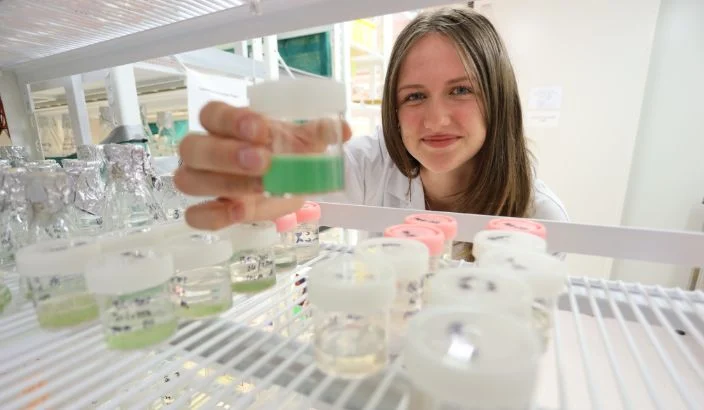
Enhancing phosphorus removal from wastewater using microalgae was the crux of a former Nayland College student’s 10-week research programme at Cawthron Institute.
Annabelle McQuillan has delved deep into this area at the algae research world leader for her environmental science degree with honours at the University of Canterbury.
A Cawthron summer scholarship provided through a bequest from acclaimed Richmond teacher Madge Johnston bloomed the research programme for Annabelle, which concluded on 5 February.
She’s been thrilled by the opportunity on her home turf to learn about the micro aquatic, plant-like organisms and how they could extricate at times harmful widespread excessive algae growth, currently fed by “unsustainable” phosphorus use in fertilisers.
“If you’re encountering algae in a water body, that’s probably not very good, and you probably want to stay away, but working with microalgae is really cool, it can be used for a lot of things,” she says.
“To get phosphorus, you have to mine it, and it’s a finite resource, so it’s going to run out in the next 30 to 300 years. “The whole point of using microalgae as a bio fertiliser is that it stores phosphorus as polyphosphate granules, so if you add it to water that has had fertiliser runoff with excess phosphorus in it, it can recycle it and then be applied back to the land.”
Annable says work using manganese to accelerate the microalgae’s ability to uptake the phosphorus was done at Cawthron Aquaculture Park at Glenduan.
“It was shown that without the manganese it took about 24 hours, and then, with the manganese, it took an hour,” she says.
The institute says research demonstrating the improved phosphorus removal and recovery by triggering microalgal polyphosphate synthesis in the laboratory now needs to be replicated in a real-life setting.
Annabelle says she’ll consider further experience at Cawthron over the next three years of her degree and possibly an internship with Nelson City Council.
