
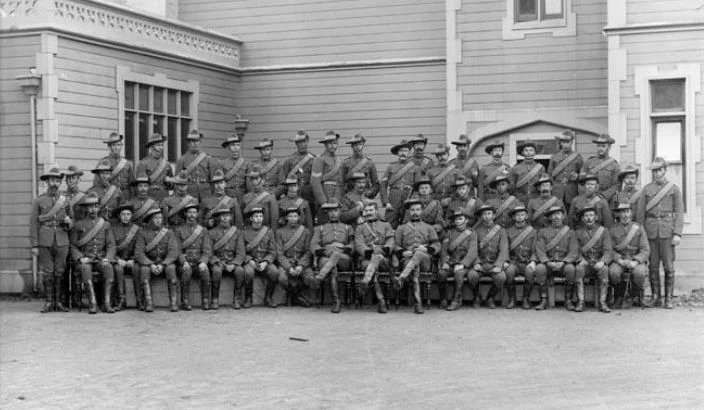
The Motueka Mounted Rifle Volunteers was one of four squadrons that formed the 1st Regiment, Nelson Mounted Rifles in 1901, the others being Marlborough, Wakatu and Tākaka.
The squadron began in late 1900 and in November around 14 new members were sworn in, with Mayor Hursthouse administering the oath.
Another 19 were to be sworn in at a later date. The Upper Moutere contingent of around 25 men had joined the Wakatu Rifles for a 12-month period, but at the expiration of that time were willing to join Motueka conditionally upon Lieut.
Oldham being elected 1st Lieutenant of the Motueka Corps. Dr Deck was appointed as Captain; 1st Lieutenant Mr A. Askew; 2nd, Mr F. Batchelor; 3rd, Mr Joseph Senior.
Mid-March 1901, 17 men from the Wakatu Mounted Rifles transferred to the Motueka corps and Oldham was confirmed as 1st Lieutenant. Non-commissioned officers elected – Sergeant Major F. Trolove; Quartermaster Sergeant F. Muntz; Farrier Sergeant A. McFarlane; Sergeants F. Franklyn, A. Wright, A. Askew, Stanley Fowler and A. Kemp; Corporals A. Talbot, Senior, C. Hursthouse and P. Moffatt.
Now began the work to develop the men into a functioning and well-practised group.
One of the first tasks was for a fatigue party to dig a trench for the building of a rifle target. Drill practises were held daily as the men prepared to make their first appearance at the Easter encampment at Appleby, under the charge of Sergeant Major Healy.
The 56 men of the Motueka Mounted Rifles (under Captain Deck) reached the camp in the evening and were ordered straight to their tents. In addition there were several marquees, for the officers’ mess, sergeants’ mess, and orderly room. A canteen, refreshment booth, and oyster saloon were also available to the men. Over the following days, practices, drills and military manoeuvres, including a fake attack, took place. The Motueka men were commended for their willingness to volunteer for camp duty and for having a large muster.
Back in Motueka, the men were kept busy with practices and events and in May delivered a grand military display and sham fight for the community and visitors with the assistance of the Nelson Rifles, together totalling around 110 men. The corps marched to Mr Staples’ paddock where the ‘fall-in’ was sounded and the brigade was inspected by Captain Wolfe, officer commanding the district.
The sham fight consisted of Motueka squadron making an attack on “the camp,” which was defended by the Nelson men, all using blank ammunition. The Nelson Rifles gave an exhibition of drill, firing, bayonet, physical exercises and attack formations. The day culminated in dinner and a ball.
By December 1901 there appears to be some rumblings of discontent within the ranks. An anonymous trooper informed the public by way of a letter to the newspaper that he had been in the Motueka Mounted Rifles since its inception and he and others were fed up with the way they were treated like lumps of dirt rather than men, by the officers.
He stated that there was little to no respect for those who did not have stripes and the analogy of a ‘monkey on a stick’ was made, in that - the higher up the ranks some men went the more you saw of his tail. Allegedly, a number of resignations were threatened.
In March 1911 the unit was renamed the 10th (Nelson) Mounted Rifles. They were mobilised during World War I as a squadron of the Canterbury Mounted Rifles Regiment.
