
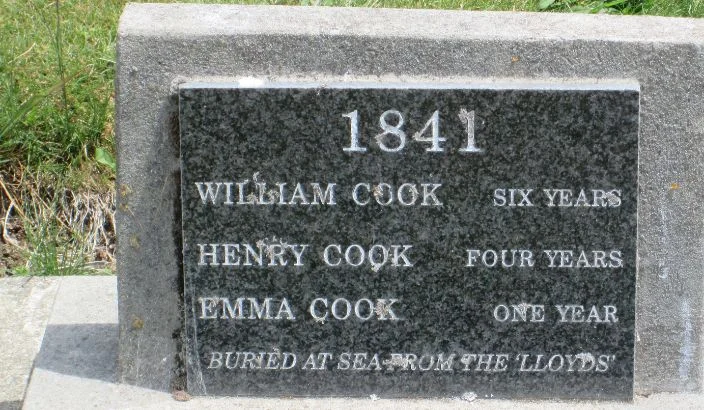
Sitting within Riwaka Cemetery is a memorial headstone that causes one to stop and reflect, evoking a sense of sadness and loss.
The headstone is in memory of James and Johanna Cook’s three children who died on the voyage out to Nelson, sailing on the ‘Lloyds’.
In 1841, three expeditionary ships, Will Watch, Whitby and Arrow, left England to select the site for the settlement of Nelson.
On board the Will Watch and Whitby were over 100 men, surveyors and workers who would find and prepare the site for New Zealand Company’s second settlement. The workers chosen were all married, and many left wives and children behind, however they knew that they would follow later. James was on board the ‘Will Watch’.
The first four emigrant ships arrived in Nelson in February 1842, these being the Fifeshire, Mary Ann, Lord Auckland and Lloyds.
Johanna was onboard with her five children, George, Ellen, William, Henry and Emma, but sadly lost Emma aged one on 13 October, William aged 6 years on 25 October and Henry aged 4 years on 13 November.
The Lloyds carried the families of the men who made up the expeditionary force, totalling around 75 women and 133 children. Having been separated for around 10 months one can only imagine the excitement of the men in Nelson being reunited with their wives and children. However, this was not to be, and the Lloyd’s arrival brought great sadness with the news that 65 children had died on the voyage from England to New Zealand, with some losing all of their children.
So, what happened on the ship to cause the death of all these children? The blame was put squarely on the onboard physician, Dr George Bush, and on the captain of the ‘Lloyds’.
The doctor, being responsible for the welfare of the passengers, had questionable qualifications, failed to inspect the general health of the passengers before embarking, was totally unprepared and unable to cope and was not able to supply the passengers with the food that they needed. The captain was blamed for the immoral conduct of some on the ship, for having formed a relationship with one of the passengers and for failing to set an example.
Through the failure of the doctor to check the patients one family were able to board with children suffering from whooping cough, and within a short time it spread throughout the ship. Most of the children who died, however, did so from extreme diarrhea.
James and Johanna, with their remaining two children, settled in Riwaka whereby with hard work and perseverance they were able to forge out a good life on their farm of sixteen acres freehold and 100 acres of grazing land. Their house sat close to the long range of hills which separated Riwaka and Takaka and it was a regular occurrence weary travellers arrived to find a haven of rest and both they and their horses could be refreshed at a moderate charge. The couple welcomed a new child, Dinah into the family in 1846.
James died in May 1869 aged 62 and was buried in Riwaka Cemetery. Johanna lived another 13 years and died in March 1882, buried with her husband.
