
The twice-weekly bus links servicing both Motueka and Tapawera need a boost in demand to safeguard their future, the operating trust says.
It is close to 20 years ago since Motueka last had daily bus services as, one by one, they became unviable and dropped away.
With the advent of the eBus, there are once again multiple weekday services, and a charitable trust has been bridging the weekend gap that the eBus has not yet filled.
The Nelson Tasman Community Transport Trust (NTCTT) was running services through to Richmond several times a week before the eBuses were up and running, and the trust’s services are part of what proved this local demand to the council.
However, transport trust coordinator Jude Tarr says that they would love to get more bums on seats on the weekend’s once-a-day return services, to really prove that there is a need and to secure the run’s future.
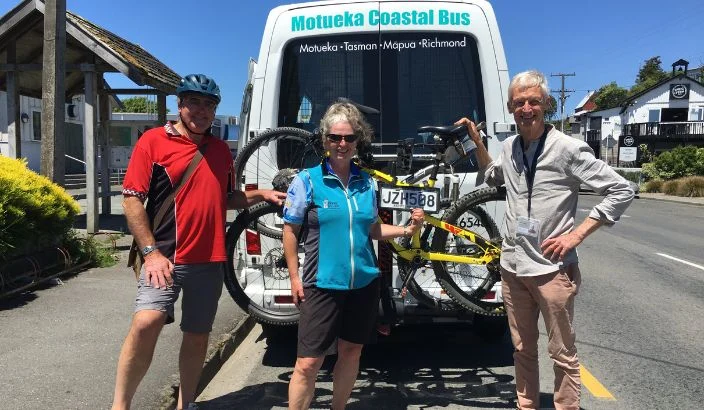
The weekend bus is unique in that it can pick up directly from people’s houses, providing they are on the main route and there is a standard pull-off space for the van. This smaller coach also has up to five bookable bike spaces, which gives certainty for cyclists. The cargo area means that “expensive bikes with strange geometry” have a safe spot too.
“We are a small trust, so we are able to be quite nimble and flexible,” Jude says.
“We are also very determined to get carbon emissions down, as transport is one of the worst offenders in that aspect.”
However, getting people out of the habit of using their cars was “taking quite a shift”.
This is particularly true on the trust’s twice-weekly Tapawera route which runs a return trip once each week between Motueka and Richmond. This service is currently being trialled and will be reviewed in March.
Jude says it has had “a little bit of support, but we really need big support to continue to do these things”.
They’ve listened to community feedback and trialled changing the day, as well as offering a cash fare option.
In theory, the community has expressed a need for the service, but in practise, “it’s really hard to get rural people out of their cars”.
