
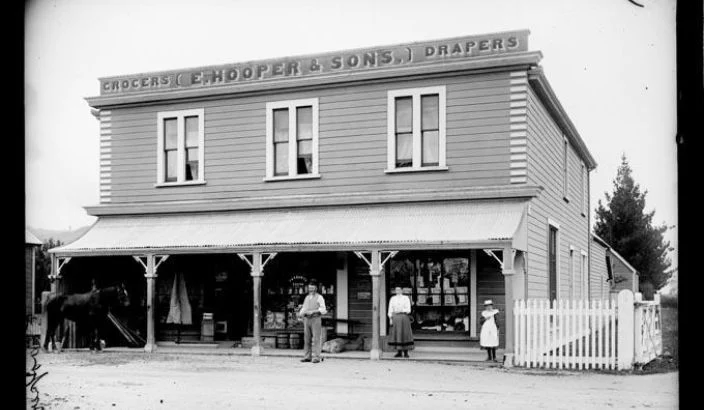
At the Magistrate court in October 1925, Mr Coleman, county inspector for the Waimea County Council proceeded against Hooper and Sons, storekeepers of Wakefield for carrying on the business of hawking within the county without a license.
This became a test case for the future of exactly who could be classed as a hawker. Mr Moynagh, for the defendants, pleaded not guilty.
It was not uncommon for country storekeepers to send their delivery vans out over quite a wide area to sell direct to the customer, and this raised the question as to whether the council could charge them hawking fees. Under the council by-law there was no definition of a hawker, and it was admitted by the defendants that they were not licensed, but felt they had no need to be, as they were not hawking their goods.
Lawyers looked at the definition of the word, taking in a few versions. In the English Act a hawker was “one who carries about goods for sale and cries out for sales”. Burns’ Justice definition was “an itinerant trader who goes about from place to place carrying with him and selling wares.” As far as Fell was concerned, Hooper & Sons’ actions fitted under that definition. Witnesses gave evidence as to making purchases from the defendants’ store cart at Dovedale, and also of the selling of cigarettes to a casual stranger. It was also determined that if a new resident came to the district, it was quite probable that the driver asked if he could call.
Moynagh argued that the firm did not make a practice of selling goods to anyone apart from regular customers, meaning they were itinerant traders as opposed to hawkers. On cross examination, the witness confirmed they heard no calling out nor saw signs of solicitation.
Magistrate T. Maunsell found that Hooper & Sons were to be charged with carrying on the business of a hawker in the Waimea County without a license, contrary to the County by-law requiring Hawkers to be licensed. In considering the question for the meaning of the word ‘hawker’ - the defendants were storekeepers and had a fixed place of business in Wakefield.
In addition, they travelled round the country with goods for sale. The larger proportion of these were ordered in advance, but the sale of other goods were made regularly to customers of the defendants.
Hooper & Sons combined the carrying out of the business from a fixed abode with the business of hawking, and therefore was competing with licensed hawkers.
The interpretation had to be made that there must be some solicitation in some way. The defendant carted the goods in the hope that, when he called on a customer, even to deliver goods already sold, other goods would be inquired for.
Having a van with the name of the firm painted on it meant advertising goods for sale, and hoping that people, on seeing the sign, would be induced to buy.
The charge of carrying on the business of a hawker was made, a conviction recorded, and Hooper & Sons ordered to pay costs of £1, 28sh, 6d.
