
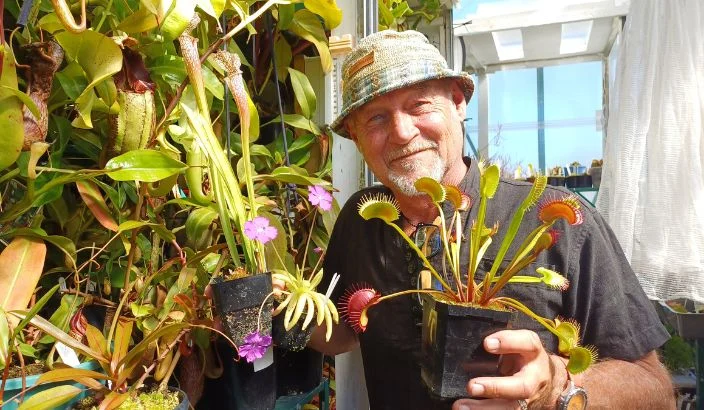
Carnivorous plants have been around since the time of the T-Rex, and Rod Attenburrow reckons that, after 60-odd million years of evolutionary tweaks, the plants are pretty good at what they do.
Rod and his partner Sue McGregor love telling the stories of the many hundreds of critter-consuming plants that they lovingly propagate in their Moutere Valley business, ‘Fatal Attraction’.
There are the Nepenthes and Saracenia that entice insects to fly from plant to plant to get drunk on the nectar like an invertebrate pub crawl, before falling into the pitcher to be reabsorbed as plant food.
The native Utricularia can open its trapdoor in 1/50,000 of a second, causing a vacuum that sucks a nearby critter into its trap when its delicate hairs have been triggered.
And then there are the glimmering sundews, whose delicate tendrils are speckled not with dewdrops but with sticky fly paper-like goo.
Sue is, with delightful irony, a vegetarian, but over the past three years, her abundant vegetable plot has been squeezed out by the carnivorous plant hobby that transfixes them both.
“We went down the rabbit hole – totally addicted,” Sue reckons, and Rod adds, “The tomatoes and aubergines were kicked out of the greenhouse.”
They now have more than 100 varieties of Nepenthes or pitcher plants, more than 30 types of delicate little Pinguicula or “pings”, and 20 different Drosera or sundews, as well as an array of notorious Venus fly traps.
Despite their exotic heritages, the plants are remarkably easy to care for, the couple reckons.
Most of them like to stand in water on a windowsill, with no fertiliser and “not too much love”, Rod says.
Anything that is fussy and more specialised are reserved for specialist collectors.
The plants go dormant in the winter, but Rod and Sue certainly do not, instead spending six weeks in the potting shed to propagate, prick out and repot their next round of babies.
Their plants are sent around the country and are also available from spring to autumn at the many markets, including this weekend’s Richmond Plant Market.
The market, which is in its fourth year, was formerly an exclusively indoor plant market.
It has since expanded to encompass edibles, aquatic plants, mosses, carnivorous plants, and natives, as well as many rare tropical and indoor plants.
There will also be two kokedama workshops, as well as food and drinks available to support Richmond’s Manaaki Kai group.
The event has expanded in popularity year-on-year, and this year, the 20-plus vendors include four from Motueka – Fatal Attraction, Moss & Myrtle, Leaves and Inflorescences, and Saphire Spark.
The Richmond Plant Market is to be held in the Richmond School Hall, 14 Cambridge St, on Saturday, 29 March, from 10am-2pm. The entry fee is $2.
