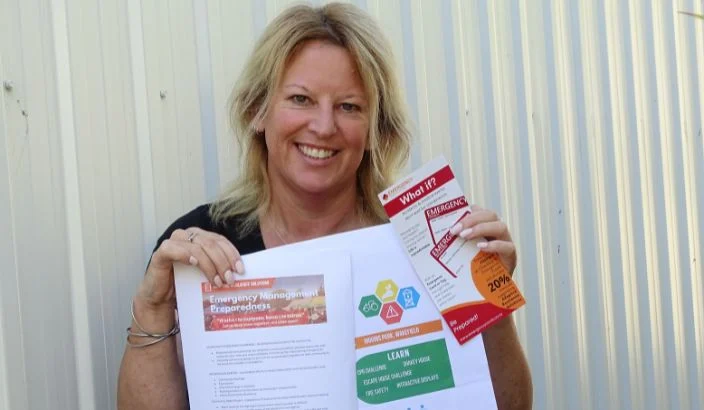
When disaster happens and communication, water, food – life as we know it – is suddenly in chaos, Dot Ashton has a plan.
It’s a plan that is growing, or as she says, is taking on a life of its own, as she works with a small team to create resilience and solutions.
Her team has created a charitable trust to build emergency management preparedness because she says it is desperately needed in communities for when the unexpected happens such as a flood, fire or the dreaded AF8 – the big rupture in the alpine fault.
So far, it has been a voluntary effort, creating Adaptive Resilience Solutions which has a website and Facebook page, organising the Rural Resilience Expo last year and she has begun working with her own community in Wakefield, after Tapawera last week, to make a plan.
“We want to build networks within communities, where each valley has its own little hub and a custodian who has emergency supplies like a radio, first aid and what they think they need in that area. The important thing is communication so we can check each community.”
That means probably seeking grants to erect communication repeaters within communities so they can check on people and seek help outside the area if access if cut off.
Dot knows about emergencies – she is the deputy chief fire officer for Wakefield Volunteer Brigade, has completed a degree in emergency management and was on the front line with the ambulance service during the Christchurch earthquake.
In the latter, she saw communities getting together on an island on the road, sharing what they had to feed people and building toilets they could use.
“That’s resilience and that’s where education comes into it – you’re not on your own. Rural communities do it really well – rural makes s**t happen. In urban, you get a bit comfortable, so we will look at doing urban resilience expos.”
If the information had been available at the time of the Pigeon Valley fire near Wakefield, she says the community would have known where to go, including their animals, which would have taken away a bit of the anxiety.
When a plan and reliable information is not in place for an emergency, she says people can panic.
“Part of the plan is what are our options? Where can we safely house people? Can you take your animals?
“Every community is very different; you can’t cookie cut it. So, we mould it for each community. You have to work with the group that have lived there a long time and use their experience.”
The plan has become multi-layered and includes planning for ethnic groups who often have their own community within an area.
It also looks at older people and people with disabilities because she has found working with those groups in emergency services, many don’t know their accurate prescriptions or health details.
Whereas, if they have those details filled out on a form available from the website, they will be able to hand over those details to someone in a welfare shelter if they must suddenly leave their home.
Dot says those welfare shelters are a crucial part of the plan and need to be self-sufficient, including a water tank, generator and solar power that the community knows about so they can flush the toilet and have a shower.
The idea is to have fixed tanks scattered around the region and already they have picked Pretty Bridge Valley, Aniseed Valley and Mārahau as areas they are needed.
“You need them for firefighting where resources are minimal, but also as a community water resource if there is a disaster.”
Households also need to plan more for disasters and Dot says people need to think bigger than three days of supplies to more like three weeks.
“We want to empower people to help themselves, because in a big event, we probably aren’t coming to help you today or the day after or the day after that.
“People need to work in their little communities in their valleys and look after each other,” she says.
The group plans to run more information events, community meetings, expo events and drop-in sessions.
People can also access information at adaptiveresiliencesolutions@gmail.com
Down the track, Dot says the mapping project may move to a subscription format as she expects it will have to keep evolving to keep up to date with what is needed in communities.
