
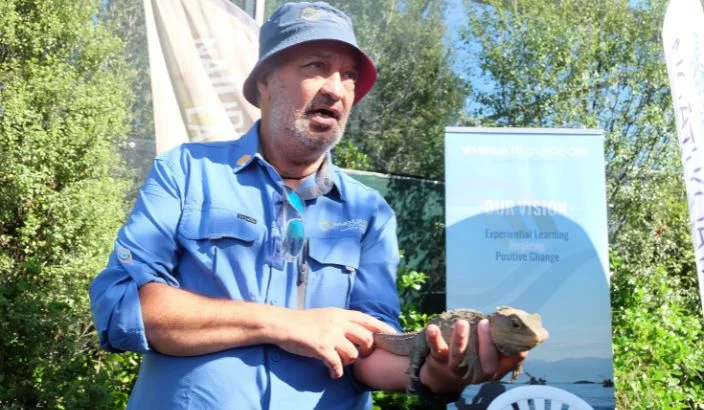
Reporter Elise Vollweiler shares what it was like to be among the lucky few who got to experience a hands-on tuatara encounter at Natureland last week.
Remember the five-cent piece? Specifically, remember the reptile perched on a rock, giving spenders the side-eye?
Mike Elkington (Ngāti Koata) is rather determined that you do remember. The tuatara is a taonga for Māori, and with Nelson being the tuatara capital of the world, “it’s Koata that holds the mana for this kaupapa”, Mike explains. The Whenua Iti kaiārahi (guide) and tuatara kaitiaki (guardian) does not want to see the creature “fade away like the five-cent piece”.
Mike was at Natureland last week to greet supporters, business representatives, and members of the Nelson City and youth councils, offering the rare chance to hold a tuatara. In doing so, he hopes that more people will become ambassadors for the creatures. Natureland houses a tuatara enclosure, currently home to three of the reptiles, but the opportunity to handle them is unique, and can only happen under Ngāti Koata supervision. There is currently nowhere in the world that routinely offers a tuatara handling experience.
Mike explains that although there are up to 80,000 tuatara in the islands off New Zealand, they are at risk because of their lack of genetic diversity. Tuatara are the only surviving members of the order Sphenodontia, which otherwise became extinct 60 million years ago. An evolutionary achievement, but as they are a single species, they lack the buffer that comes with genetic diversity.
“They’re not endangered because of their population. They’re endangered because they are a single population,” Mike explains.
Another quirk is that they incubate female eggs when temperatures are less than 21 degrees Celsius. Over that temperature, the eggs grow into males.
“What, then is the big hiccup with global warming?” Mike asks the gathered crowd.
The two tuatara able to be held are called Kōwhai and Bubbles, and Mike assures the crowd that, although they are fairly tolerant and used to being handled, such impositions are carefully managed and strictly limited.
Bubbles scuffs delicate pink scratch marks along my arm while we try to find the right position where she is comfortable, contained, and can relax into the warmth of my hands.
Her skin is cool and almost clammy - that same sort of sensation as when you kick off your blankets and then wake up hours later, chilled by the night air. I expect coarseness, but she is soft, and surprisingly delicate – I can feel her ribcage expand with her breath. Her tail though, is long, thick and seriously reptilian. Adding to her vulnerability is the fact that her skin feels two sizes too big. I have a little over a decade on her – she is 30 years old – and if all goes to plan and we each live well into our dotage, she will survive me by half a century.
Mike explains that when tuatara are in a dry environment, they pass urine in solid lumps of urea that look like chalk. You can write your name with it, he tells the crowd, and I quietly hope that someone has the honour and novelty of being peed on by a dinosaur. It does not happen, in our group at least.
Tuatara are exciting on paper – “the grandparents of dinosaurs”, Mike describes, but their conservation is woefully under-funded.
He hopes that in creating these experiences and sharing the tuatara’s tale, more people will become invested in the reptile’s well-being.
“When people hold one, when people can feel them breathing... there’s a connection made.”
It gives conservationists and potential stake-holders a “why”, Mike says – why they should support this kaupapa.
