
“It’s brought me a lot of pain and sadness because I struggled so long at school, but it’s very important to understand that it comes with advantages as well.”
Bronte author John Lazenby had a stellar sports journalism career in London, which included publishing three cricket history books.
He did this while hiding his condition which was demoralising as a child. He was diagnosed with dyslexia at around age seven, and then with ADHD in his early 60s, which had been hidden in plain sight throughout his life.
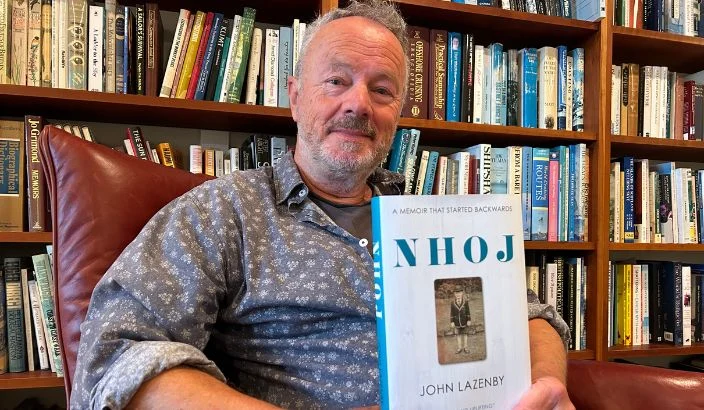
His fourth book NHOJ: A memoir that started backwards, which was released in New Zealand on 1 April, is a tribute to vanquishing those challenges, the mould-breaking teacher who transformed him, and a message of hope to his ilk and wider audiences.
John says he was illiterate at an austere boarding school he got sent to in the 1960s, and the only thing he could write was his name, but backwards, hence the ‘NHOJ’ in the title.
“[My illiteracy] was so bad that during school chapel I would hold my hymn book upside down and try to decipher the words,” he says.
“The headmaster would walk down the aisle of the chapel and grab the book from my hand, turn it the right way around and walk back, so I was hopeless.”
John says a childhood dyslexia teacher named Dorothy Shepherd, whose expertise was a rarity in the 60s, was a watershed moment.
“She started me reading and writing the very basic forms, and she used to help me by guiding my hand across the page so that I learned to form words,” he says.
“She was instrumental in changing my life, not so to get me to read and write, but giving me the confidence I’d never had up to that age and to tell me that you can do something with your life.
“I think where I am today, I owe an awful lot to her, and it would be nice if we could track her down.”
Along with his dyslexia, John realised decades later when he was diagnosed with ADHD, that his 30 to 40 years in journalism was “the perfect job”.
“My sort of atypical thinking, my curiosity and slightly different angles with my research, I feel that’s very much part of the dyslexic brain that’s helped me in those areas and probably made me in some ways a better writer,” he says.
“I covered rugby internationals and cricket test matches, but I kept my dyslexia a secret throughout my career as a journalist because as a kid I was laughed at a lot because I couldn’t read or write, I expected very much the same thing out there in the world.
“I carried ADHD all my life but I never knew I had it, and there are many hidden advantages like an ability to hyperfocus, but you have to be interested in the subject that you’re focusing on which helped me enormously when I wrote my first three [cricket history] books.”
John says he and his partner Sharon Meyer’s move to Aotearoa in 2015 gave him the freedom to unpack his dyslexia, and he was persuaded to share it publicly at Rotary clubs and women’s business groups.
Those public talks and his partner’s support were the genesis for his memoir.
“I expected people to sort of laugh, but they didn’t, and one woman ended up crying in the audience, because she thought of me being abandoned at school, unable to read or write, and finally finding my way in the world to become a journalist and an author,” he says.
“I thought, there’s obviously something here, that the story does connect with people… and I do want to send that message out that people will write you off in life, but it’s amazing what you can do if you keep your mind to it.”
