
Robyn Parkes
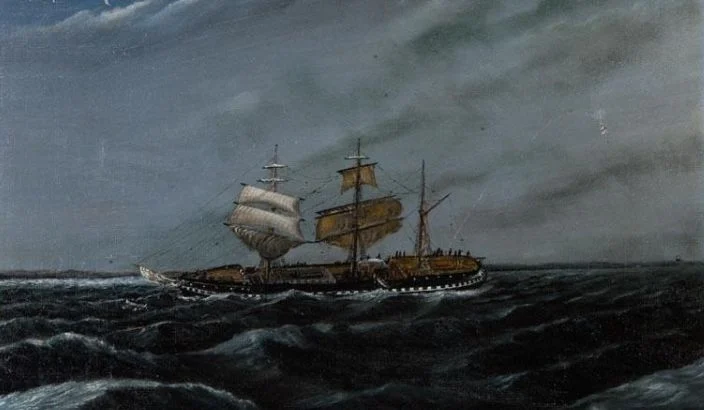
Messrs Shaw and Savill’s barque ‘Queen Bee’ left London bound for Nelson on 21 April 1877 carrying a large cargo of goods for Nelson and passengers.
The New Zealand coast was sighted around 2 August and on Monday 6th, at 8pm the ship was abreast of Farewell Spit light. Captain Davies continued on course for some time, before changing to S.S.E. At midnight, when the light was bearing northwest and showing red, she violently struck the spit, knocking the crew off their feet.
Damage assessments found 4ft 6in of water in the hold, confirming they were in trouble. The crew fired guns, put up rockets and burned blue lights, but got no response from anywhere.
John Going, 2nd mate, with four crewmen, went in search of help. Stopping at Bark Bay they found Messrs Huffam and Hadfield, who assisted them to Motueka to telegraph the agents and harbourmaster, Captain Cross, to raise the alarm.
The passengers remained on board but by 8am it was clear the ship was unsafe, so the captain gave the order to abandon it. Passengers were packed into two boats, the lifeboat and the cutter.
Around 11 passengers, women and children, were put on the lifeboat with four crew members. The cutter carried around 17 men and children and was manned also by four crew. The two boats remained together for some hours before being separated.
This left 15 still on the Queen Bee and only the captain’s gig remaining, (a boat used for transporting the captain). Nine were put on the gig and the remaining six on a hastily constructed raft which was towed behind the boat.
Back on land the local authorities had received the telegram concerning the grounding. Captain Cross boarded Lady Barkly and set sail for the Spit, followed by the steamer Lyttleton. On arriving, Captains Cross, Walker and Scott and Mr Ross, the engineer of Lady Barkly, found the ship abandoned and declared it to be a total wreck.
Multiple ships, including the Aurora from the Naval Brigade, spent several days searching the seas and coastlines for the survivors. The raft with the captain’s gig was abandoned and all men were put in the boat. After over a day’s drifting the men saw a small pocket of land on the shoreline, around Durville Island area. In landing there the gig was smashed against the waves and destroyed and one man was drowned. They remained on this small beach until 10 August, being found by the Manawatu.
The lifeboat crewman had rigged a sail from a blanket and made for Awaroa landing around 36 hours after abandoning the Queen Bee. They found the Hadfield brothers’ house but with no one at home, although they were able to find some food.
They were eventually located and transported to Nelson. The cutter was blown seaward and simply drifted. They ended up near the mouth of Puna Harbour where some of the crew went for help and fell on the Māori settlement of Rene Hoihoi where they were treated with great respect. On the 9th all the passengers made for French Pass and were picked up on 11 August by the ship Aurora and a Māori canoe.
The inquiry into the wreck commenced on 16 August 1877, and ended on the 22nd.
Judgements were made against the captain and 2nd mate.
