
Robyn Parkes
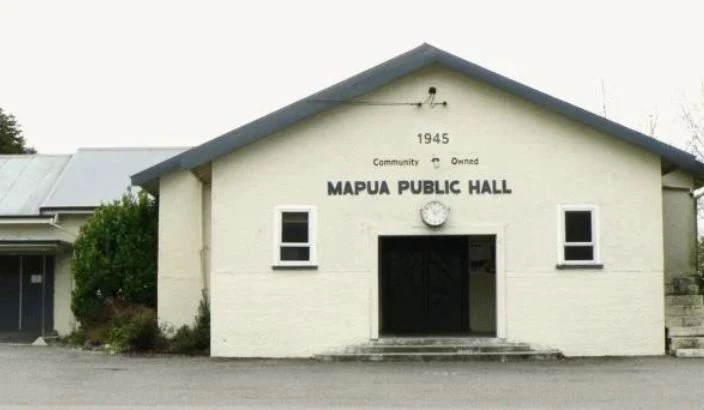
By the mid 1940’s Māpua residents had been waiting for a long time for a purpose-built hall. Whenever public functions were held, they had to be limited to the capacity or availability of whatever building was available. Such was the problem in 1944 when, in the apple packing season, the residents wanted to provide entertainment for the men in the Army Labour Camp but had to cancel due to not being able to secure a suitable venue.
The history behind the need to obtain a public hall goes back to 1917 when a social club was formed. The club was able to secure some assets for a hall and an old packing shed near the wharf was purchased from Mr McKee and adapted for a hall.
However, it was cold and proved to be unsuitable so was resold to McKee. Through investing the hall committees’ funds in war bonds, they were able to purchase a packing shed at Kina to be removed to another site. A plot of land was kindly donated by F. Ledger but this was also unsuitable so was sold and replaced by a centralised section from Mr Bevan on which the new hall was built. Wasting no time, the land was cleared, levelled, and building began in the latter part of 1944, with plans drawn up by Mr Moffatt who also supervised the work. The hall consisted of a concrete foundation, walls of concrete, iron roof and pinex lining.
The auditorium was erected at 50 by 36 feet, with a stage of 20 by 16 feet and dressing rooms on either side, a committee room and kitchen. Cloak rooms were on either side of the main entrance.
With real community spirit much of the labour was provided on a voluntary basis. This entitled those workers to membership in the Hall Society, meaning they owned an interest in their own hall.
The official opening of the new Mapua public hall was attended by almost all the residents of the district on the 10th of March 1945 and opened by the Hon. C. F. Skinner, Minister of Rehabilitation and MP for Motueka.
Following speeches and congratulations, the Minister declared the hall open. Afternoon tea was enjoyed by all and at this time the plans of the hall building were passed around to be signed by those present, the idea being to have it framed and preserved.
In the evening an even bigger crowd gathered for a concert and dance. Every seat was occupied and even standing space was hard to find with the main and side doorways filled with people.
Once supper was completed the floor was cleared for dancing and the space again was too small for all the dancers and onlookers with estimates of 500 to 600 people attending.
The hall was built with a definite purpose —to provide recreational and cultural facilities for the community. Social events, dances, concerts, sales, weddings and other informal and formal gatherings were regularly held in the building as well as the showing of movies as a projector room above the entrance had been built.
After many years of highs and lows the community had realised its dream to have a central community building in which to gather.
