
Robyn Parkes
On the evening of the 21 February 1921, the Murchison community, along with a large number of visitors, were entertained with an educational and musical treat at the Chautauqua concert.
The day ended on a pleasurable note, but as people awoke the following day they received the news of a sensational crime that occurred in the early hours of the morning.
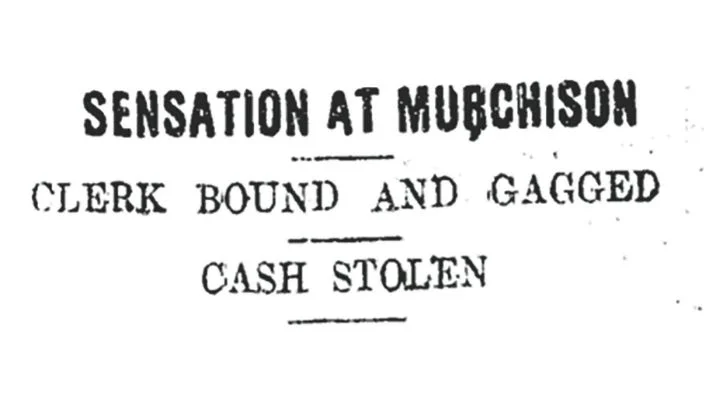
The Murchison branch of the Bank of New Zealand had been robbed and £2124 in notes, gold and silver was missing.
Around 7am on the 22nd, teller Wilfred Engall raised the alarm, and within a relatively short time detectives and BNZ representatives from Nelson and Wellington arrived on the scene to begin investigations.
Detective Young interviewed Wilfred to determine how the robbery played out.
Wilfred and a friend attended the concert the night before, after which he returned to the bank where he had a bedroom at the back of the single-storey building.
He went to bed and was woken around 3am by two assailants who bound his arms and legs with binder twine, gagged him with a handkerchief, then wrapped him up in blankets taken from his cot.
According to Wilfred, the two men rummaged around, found his keys to the safe in a chamois bag on the bank counter and took the money. Wilfred informed the detectives that it had taken him until 7am to free himself and call for help. However, there was also one report where he stated that he had fallen asleep and then awoken at 7am.
A number of mistakes had been made which made the robbery an easy task.
Firstly, the bag with the keys was left on the counter and secondly, the manager, Mr C. Ellis, had not cross-keyed the safe that night, the first time this had ever happened, meaning only one key was on the safe when the robbery took place.
It was a usual bank practice to have several locks on a safe. The keys of the safe or safes were then distributed amongst the staff making it impossible to open unless all the keyholders are present.
At Murchison, two keys held the safe and as the manager failed to lock it with his key, the thieves needed only the teller’s key. Once their objective was achieved, they left. A car was heard running through the town around the time of the robbery and was traced as far as Lyell, but there the trail ended.
The detectives found, in a cottage next to the bank, a roll of binder twine from which a piece had recently been cut off. When tested, the twine was identical to the one which bound Wilfred.
Later, in a rather bizarre twist, the detectives received a message from Mr J. Schofield informing them that he had just found a parcel under a bridge close to the town.
On arriving at the bridge, they opened the parcel of brown paper and were surprised to find the proceeds from the robbery inside it.
Rumours circulated around the township and an air of mystery remained around the bank heist. Despite further investigations it appears that the culprits were never found.
