
Robyn Parkes
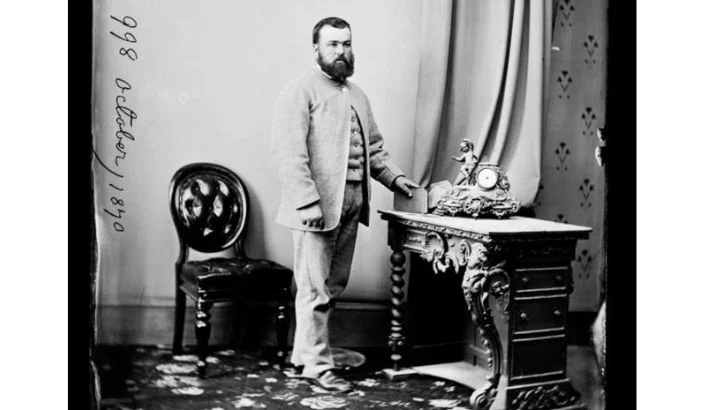
Charles Knapp (1845 – 1929) was born in Nelson to James and Ellen Knapp.
In 1867 he joined the police force, which was then under the Provincial Government, and had charge of the Waimea South district, quickly gaining a reputation for carrying out his duties with respect and courage.
In addition to the duties of constable, in the earlier part of his service he had to collect the education rate, dog tax, act as relieving officer and inspect the arms and ammunition stores.
Some of his stranger cases included having to detain a settler who had become ‘deranged’ and had shot the local doctor. On arriving at the scene, Knapp found the man wandering about a paddock but after some careful work managed to detain him.
On another occasion, along with Mr Steer (who was then the constable stationed at Richmond), Knapp proceeded to Gordon Downs after three Russian Finn sailors who had deserted from their ship. Having found them the men refused to surrender, so some tactful police work was again done by Knapp resulting in the sailors surrendering to be taken back to Nelson.
He was also one of those to investigate the Tophouse double murder-suicide of 1894. The longest journey he undertook in one day’s duty was 80 miles by road and 34 by train. On that occasion he went to the Baton where a miner had become unstable.
After considerable persuasion, he got the man to accompany him to Wakefield on a spare horse, where they caught the last train coming into Nelson. He handed over his man and had just time to catch the ten o’clock train for Wakefield, where he got his horse and rode home to Spring Grove, arriving at about midnight.
Knapp married in 1871 to Mary Ann Fowler, daughter of Edwin Fowler. Knapp retired in August 1909 after 45 years of service and was honoured at an event held in the drill hall at Spring Grove.
A programme of musical items was delivered by some very talented residents. Knapp was recognised as faithfully discharging his duties in an extraordinarily quiet manner, always being fair, and was well liked by those in the district.
He was presented with a purse of 50 sovereigns. For the rest of his life, he lived quietly on his farm. For some years he carried out the duties of Clerk of the Court at Brightwater, being appointed in 1884, and later in 1911 took his place on the Bench as a Justice of the Peace.
Knapp had a great love of sports, with cricketing records showing him as a provincial representative player. He was one of the promotors of the Waimea Cricket Association and the Waimea Athletic Association. It was said that he could claim 60 years continuous attendance at race meetings and right up to his death he attended the local sports gatherings.
He was also one of the pioneer members of the Mansion of Peace Lodge of Oddfellows, of which he was a trustee.
He and Mary Ann had 11 children, all taking their part in the community. Mary Ann passed away in May 1926. Knapp, after a full and well-lived life died in July 1929 at his residence in Spring Grove at the age of 84 and was reunited with Mary Ann in St Joseph’s Churchyard, Wakefield.
