
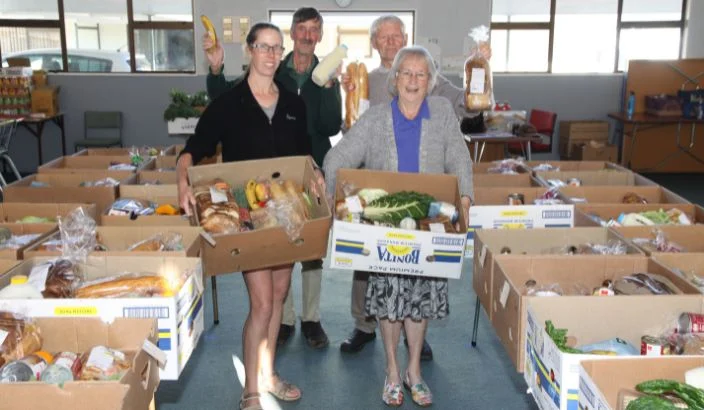
Hundreds of Motueka families are relying on charitable food services to bridge the gap in their grocery bills, with service providers saying the need is higher than ever.
Every week, Charlaine and Cliff Greaney meet their fellow volunteers at the Motueka Christian Fellowship Church on Woodlands Avenue, to sort through the many dozens of enquiries for the weekly food share service.
Together, they divvy up hundreds of food items, paying attention to how many people are in each family to balance out the supplies. A crew is in kitchen, washing, chopping and doing quality control for fruit and vegetables.
Most of the goods come from Motueka’s two local supermarkets and The Warehouse – items that are approaching their best-before dates, any excess of bakery items, and goods that are dinted or mislabelled.
“They are very good, very good,” Charlaine says of these donors.
Thomas Brothers are generous with their fruit, regularly delivering bins of apples and kiwifruit, and Frasers Orchard is also an ongoing stalwart of support – 15 pumpkins were delivered last week.
Nothing is held over – the need is urgent, and by the end of Wednesday, the food share cupboards are bare again. This service – one of several in the Motueka community – provides for about 80 families a week, although sometimes the requests climb to over 100.
“It’s certainly not going away,” Charlaine says. “We haven’t seen it go down in the last two years.”
She says that high rents are the biggest contributing factor, and many people “just can’t survive on the wages they get”. The conclusion of seasonal work also added to people’s financial troubles.
There is no demographic that is untouched by this need – solo mothers and fathers, youth, couples, families and the elderly all make up the food share clientele.
Community House manager Jane Henderson echoes Charlaine’s statement that they are seeing new families in need every week.
“It doesn’t seem to be improving any time soon.”
Jane says there is a strong food network in Motueka, with the services sharing resources and strategies to tackle the problem.
“However, it’s not a magic fix, and we don’t want for it to go on forever,” she says, adding that if they arrived in a place where there was no longer a community need for food support, “we’d be overjoyed”.
Jane points out that food is a basic need, with hunger impacting every other facet of people’s day-to-day life, including how they work or learn, how they make decisions, and even how they drive.
“If people have that basic need met, they are way more likely to be equipped to deal with any other stresses in their life.”
One woman, who was utilising the services of St Vincent de Paul and Community House as a one-off last week, says that her household was generally coping without assistance. However, “a massive hit with a power bill” meant that suddenly they were stretched beyond their means.
“It gets quite overwhelming,” she says.
The mother-of-three was in tears as she described to Jane what it meant to have the safety net of community food top-ups.
“It’s a massive help for struggling families like me,” she shared. “If you guys weren’t here for the community, I don’t know what we’d do.”
Next week The Guardian will print how and where to get food help.
