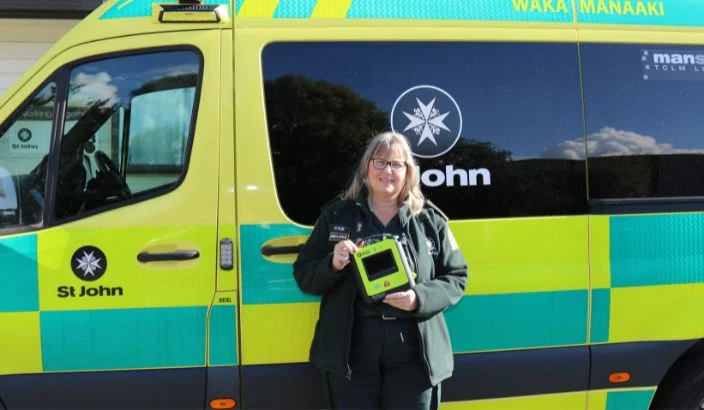
AEDs (Automated External Defibrillators) are becoming more common in schools, clubs, and public spaces, but many still wonder how they work and what to do if someone’s heart is not beating normally.
Kylie Beckers from Hato Hone St John in Richmond explains that in a cardiac arrest, calling 111 is the first step.
“Compressions — CPR — are key,” she says. “If you’re alone, call 111 and then start CPR. If there’s two of you, one starts CPR while the other grabs the nearest AED.”
AEDs, a portable life-saving device used to help someone experiencing sudden cardiac arrest, can be found with a quick web search or the AED Locations app, and 111 operators can direct you to the nearest device.
In Tasman, there are three types of AED access boxes: unlocked, those with a glass panel to break for a key, and those requiring a code, which 111 operators can provide. Once accessed, the AED talks to you, giving simple step-by-step instructions.
If used on someone with a normal heartbeat, the AED won’t deliver a shock.
“It checks the heart’s rhythm first and only shocks if needed, so you can’t accidentally harm someone by using it,” explains Kylie.
She stresses the importance of acting fast in an emergency. Often, family and friends are the first responders, and their actions can greatly improve survival chances.
“Doing something is always better than doing nothing. You can’t make things worse.” By knowing where AEDs are, how to access them, and using them without fear, you could make a life-saving difference in an emergency.
If you would like someone from Hato Hone St John to check your AED or like to receive a free “Check your AED and Save Lives pack”, or host a FREE “3 Steps for Life” training session, which teaches how to take action if someone suffers a cardiac arrest contact: nelsonbays.admin@stjohn.org.nz
