
ROBYN PARKES
Over the years multiple sports clubs formed, including rugby, tennis, hockey, golf, cricket and table tennis, as well as tramping, soccer and billiards.
Prior to World War II, occasional sports and farmers’ days were held. The latter was discontinued but sports days were revived in November 1949, to be held annually.
With cups and trophies secured, a programme of events for all ages and stages was well organised. In the mix was wood chopping, sawing, race, jumps, married ladies’ race, children’s races, potato race, fire-pump race and a lady’s nail-driving competition.
Also on the menu of regular events were fireman competitions, weekly card and housie games, bring and buy stalls, talent quests and discussion groups.
As the forestry and village grew the need for an ambulance became apparent, as anyone sick or injured had to wait for an ambulance to come from Nelson.
The forestry department agreed to the need and an ex-army Dodge was secured and refitted as an ambulance, equipped with full medical equipment and delivered on 16 August.
The village had its own post office although it was not an easy road for this establishment.
It closed for a time due to having no one to act as postmaster, but in early March 1950 Mrs L. Bayliss took the position of postmistress, opening the office each afternoon, Monday to Friday.
In late 1953 it was moved to a building in the centre of the village. Church services were held in the hall on the first Sunday of each month by Rev. E. J. Storey. To cater for the children’s spiritual needs a Sunday School was started in early 1950.
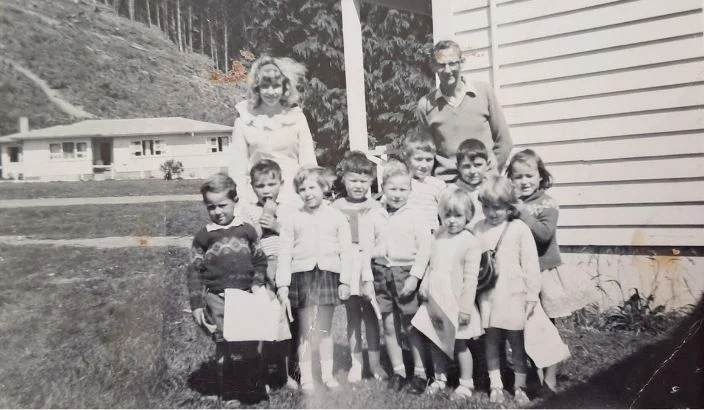
By mid-1954 there were 23 children on the Sunday School roll. In the early 1960’s, Sunday School was revitalized by George and Joy Norgate from Richmond.
They travelled every Sunday to the Downs, even picking up children from further up the valley and bringing them back down to the community hall. They continued to fill this need until the forestry was shifted to Tapawera.
In August 1953 a mass christening was undertaken by the Rev. Gregory from Wakefield with six babies being christened in the community hall.
Carrying on with the theme of babies, a Plunket Nurse visited the village on the first Tuesday of each month from August 1949. For health needs, a new surgery was opened in August 1953 with Dr J. Davis in attendance every Wednesday at 2.30.
In February 1950 a meeting was held at the hostel to discuss the matter of a sub-branch of the RSA. This was unanimously agreed to with officers elected – president C. O. Bridgman, vice-president V. Martin and secretary H. Sheppard.
Shortly after forming it was recommended that a rifle club be formed.
Later, an RSA indoor bowling club began. A Girl Guides company was formed with Mrs E. G. Mead as captain and Mrs Martin as lieutenant, in August 1953. The following year a store and garage were erected with a petrol pump available from early 1955.
By 1960 the village was complete with a population of around 260 people.
A flow of people arrived and left over the years with retirements, transfers and changes in life circumstances, but the village remained a vibrant little community until 1965 when it was deemed that the Golden Downs village and industrial area was too small to meet the demands of expanding and planting new land.
A new village, nursery, camp and headquarters was built in Tapawera and the men and women transferred to their new homes, resulting in the old Golden Downs village being redundant.
