
ROBYN PARKES
Debating societies became popular in New Zealand and aimed at cultivating critical thinking, public speaking skills, and engagement among the populations.
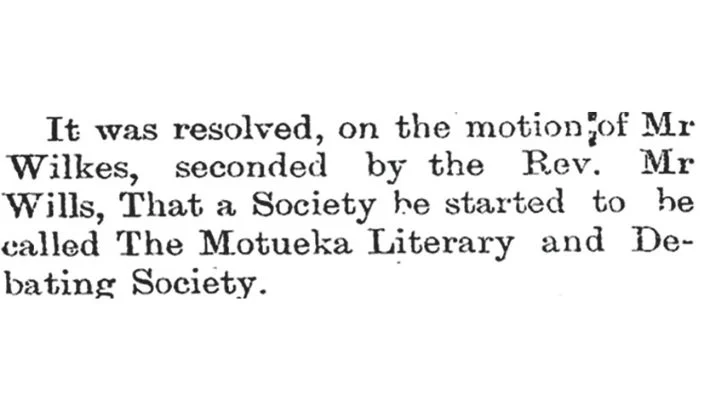
A defunct debating society in 1895 was resurrected in 1902 when the Motueka public attended a meeting to discuss the merits of starting another society.
From this, the new Motueka Literary and Debating Society came into being with T. Harris elected as president, Revs. Johnston and Wills as vice presidents; Mr Wilkes as secretary; Mr Gilbert as treasurer; and Misses Hughes, Johnston, Messrs Manoy, W. Moffatt and Symes as committee. The society then amalgamated with the Motueka Institute.
The first debate was ‘That full political rights should be extended to women’.
Mr Harris was for the affirmative and Mr Wills for the opposition. As one can guess, this was an interesting discussion.
In June of the same year the topic was ‘Is the influence of the Press greater than that of the platform’? A great discussion ensued with the weight of argument being in favour of the power of the press. Other topics during the winter sessions included ‘Is England a decaying nation’ and ‘Is it desirable to inculcate a military spirit in a rising generation’.
At the first session of the next season in May 1903 the society began with electing new officers before getting straight into the topic on ‘novel reading is harmful’.
This was a well contested debate, so much so that it went too long and was called off at 10pm.
In mid-1906 Ngatimoti formed its own debating society, in part to help the young men of the district. The first meeting was of a social nature with a short debate on whether it was beneficial to have a debating club.
The first session of the following session was attended by a good crowd with both male and female present, probably due to the topic ‘Is marriage a failure?’ The affirmative was taken by Alfred Canton and the negative by Herbert Heath. Teams for both sides spoke with A. Robinson warning the single folk to have nothing to do with marriage. Judging declared the affirmative the winner, in that marriage is a failure.
Other topics held on successive sessions included ‘horse vs bicycles’ and ‘state vs prohibition’. The popularity of debating to fill in winter evenings was catching on and in May 1910 the Aorere Debating Club formed at Rockville with a large membership. The first debate took place at the Aorere Central Hall on the 23rd with the topic for discussion being ‘Leasehold vs Freehold’.
Collingwood also formed a club in May 1910 with their second debate being ‘Should New Zealand adopt compulsory military training?’ The debate became very animated with Mr Bean being for the affirmative and Messrs Sansom and Foley for the negative. Affirmative stated that ‘a country’s people had to know how to defend themselves and it would increase the physique of young men and prevent them from idling their time away in the evenings, probably from drinking and gambling. It would make them tough and would promote sport through shooting’.
The negative stated that money could be better spent - ‘If the country were invaded what good would be done from a handful of men with the population being less than one million so compulsory training should be the last scheme on, which to spend public money’.
Anyway, the men had no time for training as there was too much land to be cleared and opened up. Debating clubs were formed in all districts with many an evening spent in the pleasurable pursuit of friendly social connection.
