
ROBYN PARKES
In 1859, Daniel Johnston first observed the hematite ore at Parapara when he accompanied Dr Hochstetter on his geographical examinations of Golden Bay. In the early 1870’s, he and partner Thomas Louisson began the manufacture of hematite iron paint, made possible by the acquisition of a property at Parapara with a seemingly exhaustless supply of hematite.
Around September 1878, Johnston and Louisson sold to the New Zealand Hematite Paint Company. The company improved the works with a new plant, were operating by November 1880 and were soon producing three tons of paint per week, using four out of the six stampers at a cheaper price than what Johnston and Louisson had been able to make it at.
A year later, W. T. Pearson, one of the directors, Dr Irvine, local director, and shareholders visited the ore works to see it in full operation under the management of W. Lottain and found them to be very successful. After installing even more machinery, the works was producing half a ton of paint per working day of eight hours. By April 1884, the Company was in liquidation and the business, property, machinery, plant, races and tramway was put up for auction.
H. E. Washbourn purchased it in March 1885, operating it with his sons Harry and Arthur. Although the paint was of good quality and well-known, it only came in one colour, a drab reddish brown, but people were wanting better colours. The Washbourn brothers, through trial and error, were able to present specimens of a stone colour, venetian red, purple, chocolate and several others.
With improvements and expansion, the company was turning out around nine tons of paint each week, the value varying from £16 to £18 per ton. Geologists visited the site to assess the ore loads and estimated that there were over 50 million tons of ore, all easily accessible, lying on the top of the land and only needed to be broken up.
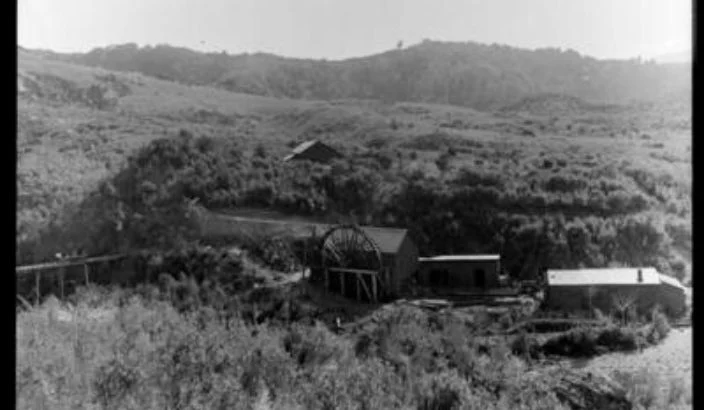
A tramway, three quarters of a mile in length, connected the battery with a bush which supplied the firewood that was required in the process of converting the ore into paint. Another tramway of similar length went from the plant to the port where the paint was shipped. The crushing plant consisted of six head of 750lbs stampers and four berdans driven by a 30ft water wheel with the water obtained from the Parapara river. The iron ore was put through the battery and crushed, then carried by a stream of water to the berdans where it was still further ground.
On leaving the berdans it passed over troughs and tables which collected all the sand and grit, the iron dust being held in suspension by the water which flowed with it into the settling boxes. After it settled to about the consistency of cream it was removed to the drying kiln under which was a fire kept constantly burning.
The drying process could take as long as 36 to 48 hours. When thoroughly dried, it was put through a coarse mill preparatory to undergo further grinding by passing through close steel rollers which reduced it to a fine powder. If it was to be sold in its dry state it was bagged and put into cases, but if it was to be in a ready state it was mixed with 30 per cent oil and with this once more passed through a grinding mill and put into tins of various sizes.
In 1906 the brothers sold the business to a syndicate who had plans to develop the iron deposits for making steel. The paint works remained, but by 1922 was no longer in use.
