
ROBYN PARKES
Flood damage to Waimea West Road and roadside properties was an ongoing problem for Waimea County Council with Eves Valley stream causing much of the problem. Floodwaters often impeded traffic, and landowners were identified as exacerbating the issue by allowing the banks of the stream to be blocked and overtopped.
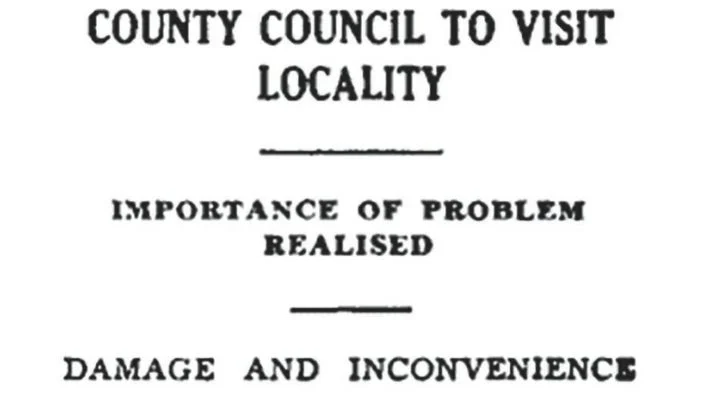
In 1935 the issue became more urgent with a council committee asked to inspect flood scouring.
It was recommended that the road be raised above flood level to prevent the water crossing it and then coming back further down.
Landowners were asked to assist in clearing the gravel from the stream, thus lowering it to prevent flooding.
Despite continued conversations, three years later nothing tangible had been done, and the council was receiving multiple letters of complaints.
Attention was drawn to the damage and inconvenience caused to people living on the east side of Waimea West Road through the ditches overflowing and flooding the low-lying portions of their properties.
In February 1939 notices were served on all landowners adjoining the stream to remove weeds and gravel and to other landowners to clean frontage ditches on the eastern side of Waimea West Road.
As a remedy, some suggested diverting either the stream or road, but this was expensive. Others believed raising the road would work and most councillors liked this option. However, a good number of landowners disagreed with it.
At this time the issue became contentious with Mr Moore, landowner, indicating that if they went ahead with raising the road he would withdraw from an agreement that allowed the council free entry to his property for metal from the creek.
With confusion and a perceived lack of transparency, Moore and a second landowner engaged a solicitor who forwarded a letter to the council expressing regret that they were determined to involve his clients and the council itself in costly litigation.
The two men were charged with failing to comply with a council order and were served notices to appear in court.
The case was dismissed after it was found that the due formalities in the signing of the council’s order had not been complied with.
Moore, in telling his story, stated that he was approached to allow the council to remove gravel from the stream, to which he agreed.
Then he was asked to allow the stream to be diverted on his land, to which he agreed.
Next the council wanted to raise the road, but this meant the road would become a dam keeping all the flood water on the west side of the road, and he withdrew his offer of free access. He had cleared his ditches but had not removed any gravel, so to move forward the council proposed that Moore, and others, would provide five days free labour on their land to shift gravel or cover the cost for the council to provide a man. This, however, fell through.
Further inspections of the road after heavy rain found that ditches on the eastern side of the road were overflowing, resulting in flooding for 22 chains (about 40 metres).
The council pushed forward with raising the road from Nalders corner to the church, which was decisive.
At the end of 1939 there was finally agreement that this was the best option, and a tender for the raising and metalling of approximately 32 chains of Waimea West Road, together with reinstatement of flood banks along Eves Valley Stream, was successfully won by Kennings Ltd.
