
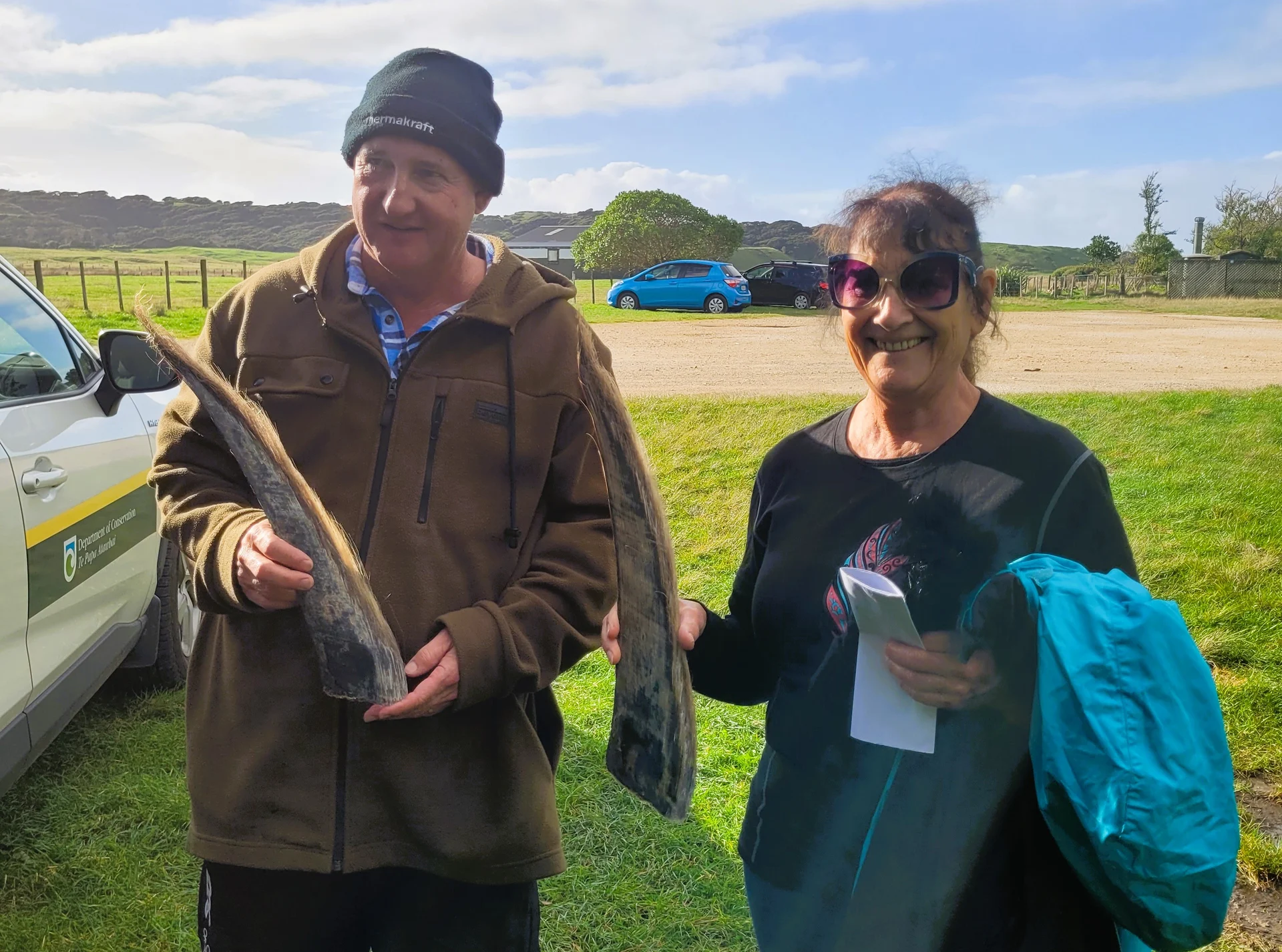
Two treasured pieces of whale baleen will soon go on display at Onetahua Marae in Golden Bay, after being returned to local iwi through the Department of Conservation (DOC).
The baleen – part of a whale’s filter-feeding system and considered a taonga by Māori – was initially purchased off Trade Me by an Auckland-based woman unaware that a DOC permit is required to possess marine mammal parts.
Baleen is the filter-feeding system of plates inside the mouths of large whales like humpbacks. The inside edge of each plate has a hairy fringe which acts like a sieve or filter, straining prey from the water.
Each baleen looks like a large solid feather and is a popular subject of artwork around the world. It is strong and flexible and made of the same protein that makes up human hair, and fingernails.
Under the Marine Mammal Protection Act, anyone who possesses marine mammal part(s) must hold either a permit or an exemption letter from DOC.
The buyer, who asked not to be named, looks out for marine items for sale and loves to sketch objects like shells, bones and rocks.
“When I saw the baleen on TradeMe, I was super excited and bought it straight away,” the buyer says.
“I just assumed the seller had a permit for it, but they didn’t. They told me DOC had contacted them about the baleen. I rang DOC for advice and the permissions staff told me I could apply for a permit or surrender the whale baleen to a research institution or find out where it came from and offer it to local iwi.
“I wasn’t in a position to pay the processing costs for a permit, so I tried to find someone to take the baleen, but it’s difficult as you need to have what’s called provenance or a purpose for it, and everyone I contacted said no.”
DOC permissions advisor Max Clark says DOC gets about a dozen similar calls a year.
“There are strict rules around how whale parts are acquired and that’s important as these taonga are very culturally significant to whānau, hapu and iwi,” Max says.
“People don’t realise this is a part of our job, and it’s to protect nature and the special taonga we have here. It can be a complex process in terms of how the parts have been acquired and that’s why people should always seek advice.”
With a bit of investigation, it was discovered the baleen had originally come from the Nelson area and, with the help of DOC, the buyer sent it back to the local DOC office to the care of Barney Thomas who is the Pou Tairangahau (a designated DOC staff member who leads strategic relationships with whānau, hapū and iwi in their allocated area of Aotearoa).
“These taonga have huge significance. I took delivery of it and gave it to Manawhenua Ki Mohua who represent Ngati Tama, Ngati Rārua and Te Ātiawa within the Takaka area. They were very grateful to receive and will put it on display at the Onetahua Marae and use it for educational purposes in the local schools and community,” Mr Thomas says.
“Educating the young people about these taonga is very important, for empathy and understanding about the mauri of that whale.”
TradeMe policy and compliance manager James Ryan says, while the sale of marine animal parts is not a common occurrence onsite, this incident serves as a timely reminder for people to be aware of their responsibilities when trading. The site content has been updated accordingly so that no one else is “caught unaware”.
