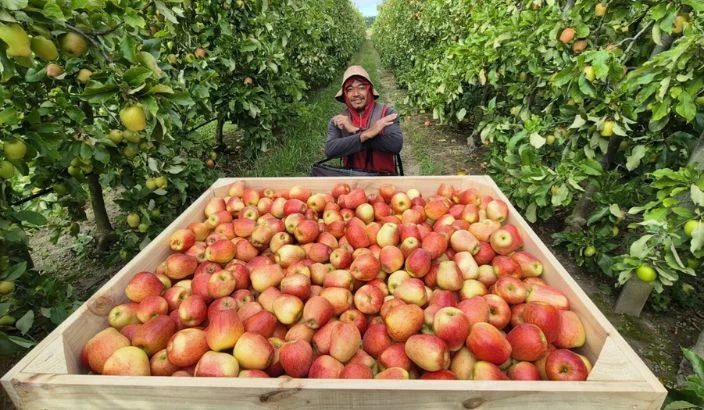
The 2025 apple harvest across Nelson, Tasman, and Golden Bay has fallen short of previous years, with yields down by 10–15 per cent due to challenging weather and an unpredictable global market.
“The cloudy weather from mid-December to mid-January affected crop growth more than expected, and the December hailstorm caused over 5 per cent losses in some blocks,” Richard Palmer, managing director at Willisbrook Orchard in Brightwater, explains.
“As a result, fruit sizes were smaller, and overall harvest volumes were about 10 per cent down across the board,” he says.
Golden Bay Fruit’s Evan Heywood reported similar outcomes, citing a 10–15 per cent drop in harvest volume due to weather events.
“In particular, the hailstorm on 30 December, even with a high percentage of blocks being protected with hail net, a number of younger uncovered blocks of high-value varieties were affected the most,” Evan explains.
Despite the reduced crop, both growers remain cautiously optimistic about current market conditions.
“Current market conditions remain solid; China has picked up recently after significant early shipments from New Zealand have largely cleared,” he says.
“The UK and the EU look positive on the back of low inventory levels of domestically-produced apples.”
Richard shares his outlook, acknowledging that while some growth markets are beginning to slow, overall demand remains strong.
“The market is generally pretty good,” he says.
“Quality continues to be rewarded, however, global conditions are affecting trade flows and customer purchasing power. The effects of Trump-era tariffs are still being felt in some economies—but they’re also creating opportunities, as U.S. product is either shut out or not wanted. That unpredictability is causing unease for us and our customers.”
The ongoing global cost-of-living crisis is also shifting consumer behaviour.
“Consumers are definitely more focused on value,” Evan says.
“It’s a worldwide issue and very tangible across all markets, including Asia.”
And, with price sensitivity on the rise, both growers agree that the future success of apple sales will depend heavily on maintaining high quality fruit standards.
Export logistics have added further strain, especially in the Nelson region.
Richard describes shipping as “more difficult and as costly as during Covid,” citing unreliable schedules and long transit times that have already discouraged some overseas buyers.
“This is an issue for the Nelson region as a whole,” he says.
“Scheduled services are becoming increasingly unreliable, and with extended transit times and uncertain delivery windows, some customers have already chosen not to buy Nelson fruit,” he explains.
In response, Freshco Nelson, of which Willisbrook Orchards is a key supplier, shipped a sizeable portion of their apple crop via ferry to Napier for improved export shipping options.
Looking ahead, both growers say the season has prompted a reassessment of business strategies.
Richard emphasised the importance of balancing cost control with maintaining quality.
“A year like this always leads to a review, and we’re looking closely at all aspects of the business, including crop strategies and costs.
“Despite positive returns, a small reduction in volume eats into already tight grower margins, which are already small from rising costs.”
Evan says Golden Bay Fruit is examining ways to reduce costs in areas they can control, such as electricity expenses and improving packhouse productivity, without compromising quality.
“The future for next season looks positive, provided the quality meets our customers’ expectations,” he adds.
Despite recent pressures, the focus on quality and efficiency remains as they adapt to shifting markets and use the next few cooler months to prepare for next season.
