
BY ROBYN PARKES
Community halls have always been spaces that foster social interaction, offer a range of activities, and serve as hubs for local events, strengthening communities and providing resources for residents.
In September 1885, the Collingwood community began their journey to obtaining a village hall with a meeting taking place in the Commercial Hotel.
To be successful in developing a hall, the Collingwood Public Hall Company was formed with 300 shares at £1 per share. A. Maginnity was elected for the position of chairman, R. Peacock for secretary and Messrs Riley, Allan, Fletcher, Irons, Nicholas, and Peacock as directors.
The chosen site was land fronting Tasman Street belonging to William Gibbs, who sold it for £40. Tenders were called for the construction of a hall to seat 200, with a stage and anterooms to enable theatre companies to visit, but no suitable tenders were received so it was readvertised on a slightly reduced scale so as to bring the cost of building within the capital of the company. The successful contractors were Messrs Shaw and Willicombe.
As the day dawned for the hall opening on 26 March 1886, the weather was bitterly cold and wet. Thankfully, as visitors began to arrive by boat, foot, horse and buggy, the sun broke through and they were welcomed by the sounds of the Takaka Brass Band.
The new hall, costing £400, was around 74ft long by 28ft wide, had two anterooms of 14ft, leaving 60ft for the hall proper from which was a stage 10ft wide.
The hall was declared to be officially opened and was followed by a concert with the Choral Society and Mesdames Gilbert and Robinson providing musical items.
An evening ball was enjoyed by all and continued until daylight. The admission fee of 1sh for adults and 6p for children was charged to go towards the hall costs.
Sadly, it was destroyed in the fire of 1904, but with great reserve a rebuild was planned, although not everyone was in agreeance. There were some who felt that the hall was never going to be a payable investment.
The Hall Company and shareholders forged ahead with inviting tenders for a new building and, while still under construction, bookings for its use were already being placed. By October 1905 it was completed and stood for 32 years before again being destroyed by the disastrous Collingwood fire of January 1937.
Another hall rose from the ashes and was opened in October 1938 with a grand fancy dress Movie Ball, decorated with coloured lights and native ferns. The building was named the Star Theatre and had a dancing floor that was some 500 square feet larger than the previous hall.
The Collingwood Public Hall Company was praised for its efforts and persistence in the face of adversity. The building cost around £2000, gained through a loan through the efforts of N. J. Doogan and was to take at least 15 years to pay off.
The hall was taken over by Collingwood Amusements Ltd. In 1953, additions were made to the Star Theatre which became a War Memorial Hall. Room was included in the plans for a library, which was also to be used for meetings of various organisations.
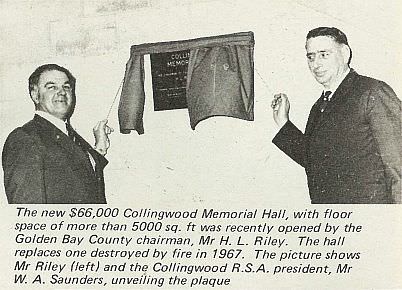
For a third time the hall was destroyed by fire, this time in December 1967, but was replaced in 1972 with a purpose-built Memorial Hall with a floor space of 5000 square feet, including a small library.
Opened by the Golden Bay County chairman, H. Riley, with cost around $66,000.
