
Jenny Manton has gone well outside her comfort zone to successfully tackle one of the world’s great treks from Lukla in the Himalayas to the Everest Base Camp. She talks to Adrienne Matthews about a journey that required grit while giving back the gift of growth and gratitude.
I hadn’t thought of attempting such an adventure, but one of my inspiring clients planted the seed when she said she was thinking of doing something big and contemplating a trip to Base Camp. The idea gradually took hold that perhaps I could do it with my husband, Andre. I love being in the outdoors and every chance I get I am hiking somewhere. A few years back I participated in an Oxfam 100km Trailwalker fundraising event, so I knew I had it in me to train hard.
There was a lot to consider. It meant closing my business, HAIR-itage Studio, for a month, along with a substantial amount of fitness preparation. We already had a good level of hiking/walking ability, but I knew I didn’t have enough overall body strength.
Booking six months in advance, there was no choice but to go all out and train. We joined a gym, and I got myself a personal trainer. Just as well, as I quickly found I had so much to work on to strengthen my back, glutes – everything really. The four to five nights a week at the gym were non-negotiable and relentless and there were many times I thought I just couldn’t achieve my goal, but by the time we were in the air and on our way, I had made peace with myself that I had done absolutely everything I could to be prepared.
Bumpy roads and breakdown moments
Arriving in Kathmandu at 11.45pm, our bags were thrown into the back of an ancient white Starlet lacking seatbelts. It was a wild ride to our hotel along bumpy roads. I felt like I was in a movie.
When the time came to leave for Lukla and the start of the trek, we were ushered into a bus instead of the itinerary-indicated plane, for a six-hour, hair-raising ride in the middle of the night on crazy, carsick-causing roads.
The weather was claggy and, after a day’s delay, we flew into Lukla where we were greeted by our three assistant guides and eight porters.
Once we started trekking, I was grateful for every bit of balance work my personal trainer had got me to do. The trail out of Lukla was rocky and dusty. I had come from New Zealand sick with an infection and was exhausted from all the extra work and training I had done in the lead-up to leaving. On day three when we ascended over 1,000 metres, mostly on steep concrete steps I wasn’t used to, I hit the wall. There were donkeys, goats, and yaks sharing the narrow track. I got caught up in a herd of goats and felt the team pulling further and further away. Everything hit me – the exhaustion, the altitude, the culture shock. I was overwhelmed and had a cry.
Andre and I had made a pact long before leaving home that we would not hold each other back, but I wasn’t alone. One of the guides stayed with me. It was the day we crossed the Hillary Bridge. We reunited with the team at what I can only describe as the most horrendous toilet I’ve ever seen. I secretly thanked my trainer again for all the squats she’d made me do. It was a relief being back with the group. Everyone cried at some point. Everyone had their own private battle along the way.
Clean trails, clear strategy
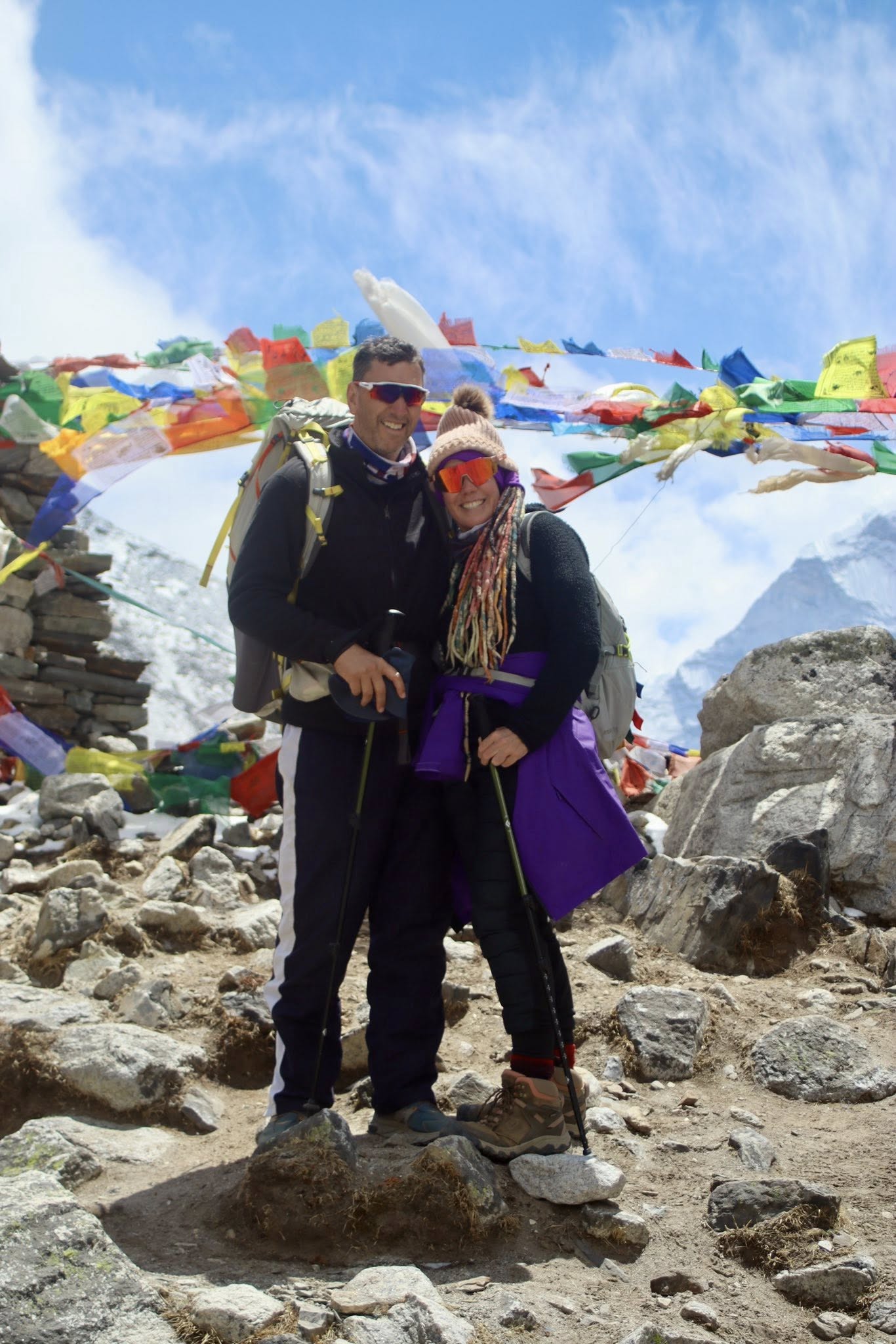
The track, contrary to what I’d expected, was spotless. There wasn’t any litter, a huge improvement from what it had been like from photos taken a few years earlier.
As we climbed higher, the air got thinner. The Khumbu cough, caused by yak and cow dung dust, hit one young man and others suffered altitude sickness. I actually felt better at altitude than I did lower down. I slept well and kept to my plan of simple food which consisted mostly of toasted sandwiches and momos which are like small dumplings. I avoided meat, raw fruit and vegetables and was the only one miraculously spared from food poisoning.
Beyond the finish line
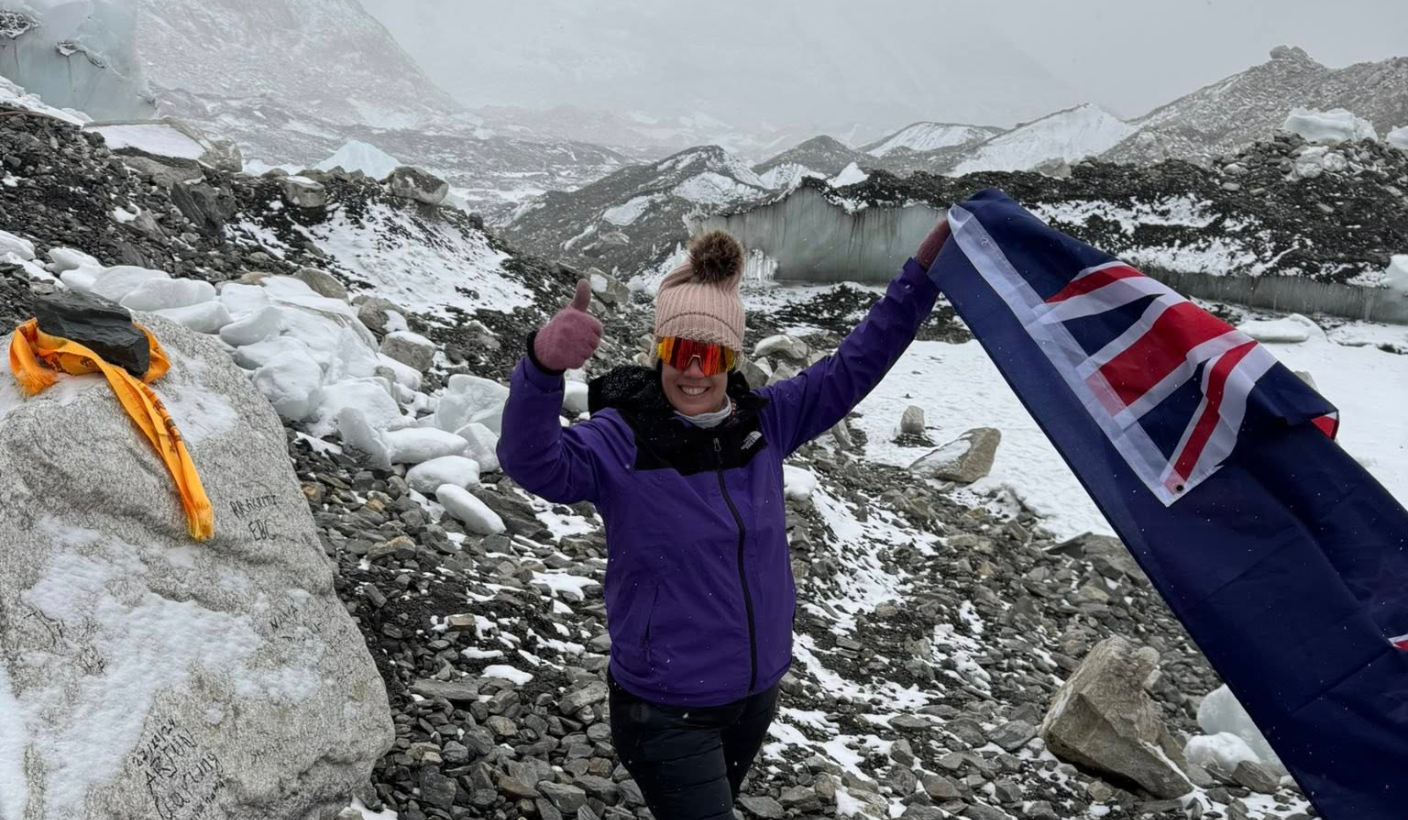
Reaching Base Camp wasn’t just a physical achievement – it was emotional and symbolic. It was both a personal and team victory but also an important shared husband/wife one. We held up the New Zealand flag, celebrating not just the destination, but the journey that began months earlier with that one conversation.
The hospitality of the Nepalese people left a deep impression. At Base Camp, at the end of a 10-hour trekking day, it was -17°C. I was layered in six merino tops, a windbreaker, and I was still frozen. A Brazilian woman’s hair was icicle-heavy. I asked a guide if I could fill my plastic bottle with hot water for warmth. Without hesitation, he insisted on offering his own. “You need this tonight,” he said. Knowing he would be spending the freezing night in the icy cold teahouse, I was humbled by the enormity of his sacrifice. It was an emotional moment the next morning when I gave him the few muesli bars and some chocolate I had found. He knew what that hot bottle had meant to me. He, like every Nepalese person we met, showed extraordinary empathy, generosity and care.
Lessons from the mountains
The trek has had a profound effect on me. Coming back home was disorienting and the experience still lingers. Nepal challenged me deeply. It made me reflect on how much stuff we have here in New Zealand; how much we complain and how disconnected we are from community. In Nepal, families live together, sometimes three generations under one roof. Their values are kindness, patience and humility. They live simply and they’re happy. We could learn so much from them.
I think of the Buddhist influence there – the calmness, the gratitude. Our world, in contrast, is noisy and distracting and full of things that shouldn’t matter. Out there, in the crisp air and picture-perfect mountains, I found peace and simplicity.
I will always remember too, the tomfoolery on the trails; the singing, jokes and laughter to keep spirits up and the comfort of climbing into our sleeping bags at the end of a big day. Also, the group fist pumps and hugs at reaching the teahouses along the way, and the joy of eating cake at the highest bakery in the world.
To anyone thinking of doing this, you can. I’m not extraordinary. I’m an everyday person who committed, prepared, and followed through. If you want it badly enough and you’re willing to work for it, you cando it. It is a journey that changes you in amazing ways.
