
ROBYN PARKES
Around 3.30am on 7 August 1866, a strong glare of a fire lit up the town, destroying multiple buildings.
The fire originated in McGee’s Nelson Hotel on the corner of Bridge and Collingwood Streets, and very quickly spread to other buildings.
The Royal Hotel, further down the street, caught fire, followed by Laney’s bakery and Macartney’s tinplate workshop and home.
On the upper corner of Bridge St, opposite Nelson Hotel, the store and home of Mr Condell was soon ablaze, spreading to a house in Collingwood St and then to the Boarding House kept by Mrs Townsend. Mr Barnes’ crockery shop, Mr Fish’s and Mr Avery’s premises were also engulfed in flames.
Meanwhile, on the opposite side of Bridge St, the heat and embers from the flames at the Nelson and Royal Hotels were carried by the wind and the Temperance Hall and the Young Men’s Christian Association were quickly beyond any hope of saving, and several smaller houses were also destroyed.
Owen’s Mitre Hotel, with its slate roof, resisted the fire for some time as an adjoining home with a shingled roof caught fire, but it too eventually succumbed to the flames. The house next to the Mitre, Mr Pratt’s butchers’ shop, was next. Mr Shone’s (cabinetmaker) shop was saved, although only the shell was left.
The fire, moving against the wind, reached another house but, with huge effort, the business premises and home of Mr Tatton the chemist was saved.
Other buildings destroyed included Dickens’ house, Beattie’s house, Barraclough’s bath establishment, Pratt’s butchery shop and house, and Leach’s wheelwright business. The Provincial Government buildings were protected by Luke Nattrass’ house which was built with zinc walls and thickly covered by a creeping plant doused with water. Unfortunately, considerable damage was done to the house.
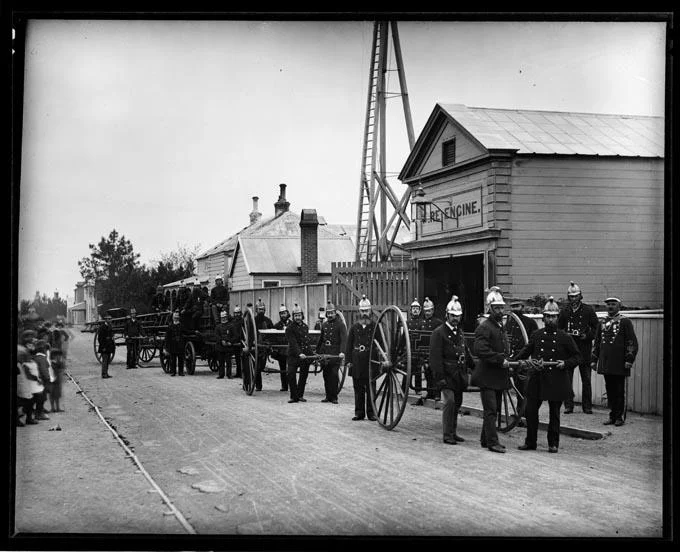
The fire-engines were kept in the street in which the fire occurred, but it took half an hour to get either of them to the spot, and when there, more time was lost before people were found to work them.
The rope of the fire bell was also broken and could only be reached by climbing up one of the posts which supported it and then ringing with the clapper. Water to fight the fire was supplied by forcing it from the eel pond (Queens Gardens) via one larger engine to a smaller one further down the road. By 5.30 the fire was contained. The loss was estimated at between £10,000 to £12,000.
Many of those who escaped the fire were left with nothing, including servants in the hotels. The cook at McGee’s, Nelson Hotel, lost all her possessions but saved the lives of four men who were sleeping upstairs.
As the inquest into the fire began, the discussion as to the need of a Fire Brigade gained some urgency. On the morning of the fire, no one had the authority to pull down so much as an old shed to stop the progress of the flames and so some decisions were made randomly. There needed to be an authority whose judgment in such cases could be relied on, so from there the steps began for the formation of a Fire Brigade in Nelson.
In true pioneer spirit the town rebounded quickly, with one owner said to have started rebuilding almost before the embers of his former house were cold. Mitre Hotel was rebuilt within three months, The Royal Hotel took a little longer, reopening in January 1867, Nelson Hotel was rebuilt by April.
