
Nelson’s local elections will see 36 people vying for 13 positions on the city council.
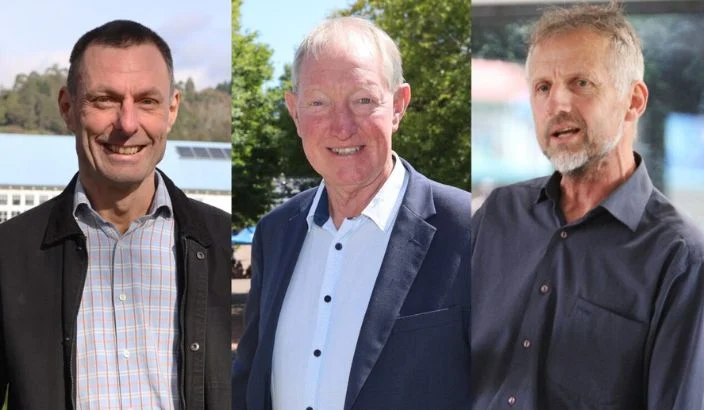
Four people are campaigning for the mayoralty: incumbent first-term mayor Nick Smith, first-term councillor Aaron Stallard, Richard Osmaston (who is also running for four other mayoralties), and John Wakelin.
Nick and Aaron are running as independents though both have past parliamentary party affiliations with National and the Greens respectively, while Richard is running under the Money Free Party banner.
Aaron is also running to be a councillor at large, rather than in the Central Ward where he was elected in the 2022 election.
There are three at large councillor positions up for grabs. Candidates running at large can be voted for by all residents, as opposed to those running for specific wards where only ward residents can vote for them.
In addition to Aaron, councillor Tim Skinner is the second incumbent to run at large.
They are joined by seven other candidates hoping to be elected by residents across the city: Chris Baillie, Anne Michele Dickinson, Susa Guhl, Jeremy Matthews, Keith Palmer, Nigel Skeggs, and Graeme K. Tyree.
The Stoke-Tāhunanui Ward has four vacancies and is being contested by nine candidates, including three incumbents: councillors Trudie Brand, Mel Courtney, and Campbell Rollo.
The Labour Party’s Sarah Kerby along with Guy Coulson, Paul Lacy, Mike Nicholls, Valmai Palatchie, and Dan Robinson are also seeking to be elected in the ward.
But the most hotly-contested ward is the Central Ward – which consists of the rest of Nelson outside of Stoke and Tāhunanui – which has four vacancies but 11 candidates.
Incumbent councillors Matty Anderson, James Hodgson, and Pete Rainey are seeking re-election in the ward. They are up against Lisa Austin, Lenny Blake, Jackie Galland, Anton Hyman, Marie Lindaya, Sand McDougall, David North, Steph Phillips, Tilman Walk, and Mike Ward.
Incumbent councillor Kahu Paki Paki is the only candidate running in the Whakatū Māori Ward which only has a single seat and so is expected to be elected uncontested.
During the local election, Nelson’s Māori Ward will also be subject to a binding referendum to determine whether it should be retained or disestablished.
Even if voters decide to disestablish the ward, it will remain in place until the beginning of the next term in 2028.
Three other incumbent elected members are not running again: deputy mayor Rohan O’Neill-Stevens and councillor Rachel Sanson, both previously elected at large, and councillor Matthew Benge, who had been elected to the Stoke-Tāhunanui Ward.
Nelson’s elections use the single transferrable vote (STV) system instead of the first-past-the-post (FPTP) system used in general elections.
Instead of simply voting for as many candidates as there were vacancies, STV means voters can rank as many candidates as they want in order of preference.
Early voting will start on 9 September, and the final day of the election will be 11 October.
Turnout at Nelson’s last local election was 53.2 per cent, above the national average of 42 per cent.