
As far as recycling goes, it doesn’t get much bigger than this.
Luisa McNabb adores her 97-year-old house, which she owned for 34 years in Christchurch. It survived the earthquakes – all 11,000 of them in her tenure, she reckons – but the neighbourhood did not.
One by one, her neighbours were bought out or moved away, and the original houses demolished. In their place, developers built townhouses – 16 in total, where four houses once stood.
“They are putting them in every orifice in the city that they can,” says Luisa wryly.
The development surrounding her 800m2 section caused drainage problems, and Luisa describes her property as “the sink” where water would pool. When it rained, she had three pumps working to contend with the flooding. The earthquakes made everything worse.
The water table used to sit half a metre down – still not that deep, Luisa reckons, but as the years passed, “it wasn’t even a hand below the surface. It was just like Venice, floating”.
The doomsday knell was when her 100-year-old walnut tree died. Luisa and her partner Adrian Stone knew they had some hard decisions to make. They couldn’t bear to just sit back and watch their beautiful garden die, but nor did they want to see the house and its many sheds and outbuildings get demolished to make way for still more ubiquitous townhouses.
Luisa has family in Riwaka and Motueka and has always loved the area. The couple stumbled across a section on School Road, overlooking the farmland and distant hills, and they fell in love.
“It’s like a country postcard,” Luisa marvels.
The pair have a strong waste-not ethos, and so with that in mind, they sold their Christchurch section and set about selling or giving away every part of it that they could. The sheds, the plants, mature fruit trees and even the chickens and coop were all rehomed.
The house itself – a wooden four-bedroom structure – was chopped in half, with the front piece reimaged as a large one-bedroom 56m2 cottage, ready for transportation to the new section. The back was stripped of anything useable – cupboards, weatherboards, roofing iron – and in the end, just the barest of shells was left to demolish.
Usually, the house comes first and then the landscaping follows, but in this unique situation, the couple is waiting for the paperwork to align before they can transport the cottage up to be placed on the freshly engineered section.
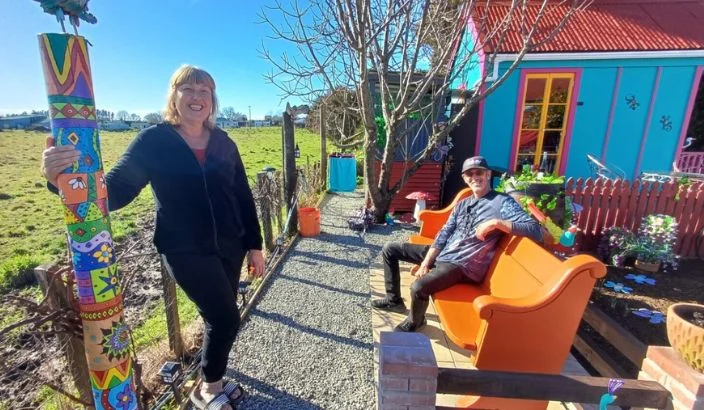
In the meantime, they have poured the last three months into creating a beautiful garden.
“We’ve had time, you see. We’ve had lots of time.”
Springtime will yield a flurry of bulbs, and Luisa’s cosmos plants – all 1000 of them – will come up in “a blaze”.
A large palm was rescued from elsewhere in the section and now sits in a front garden alongside the punga, lit by night with soft solar lighting. Elsewhere, there is a cheerful curation of garden art, including a repurposed wagon wheel and some salvaged clay planter pots made from Christchurch’s broken drains. Luisa has painted the existing outbuilding in vivid colours, which will complement the vibrancy of the incoming cottage.
“Someone said it’s like an edition of House and Garden, without the house,” says Luisa.
The house will follow in the next couple of months, as soon as the consents come through, and the couple are making do with a house truck and tent in the meantime.
Their section is just across from Riwaka School, and Luisa reckons the children there will love seeing the house over the road.
“Primary colours,” she laughs.
