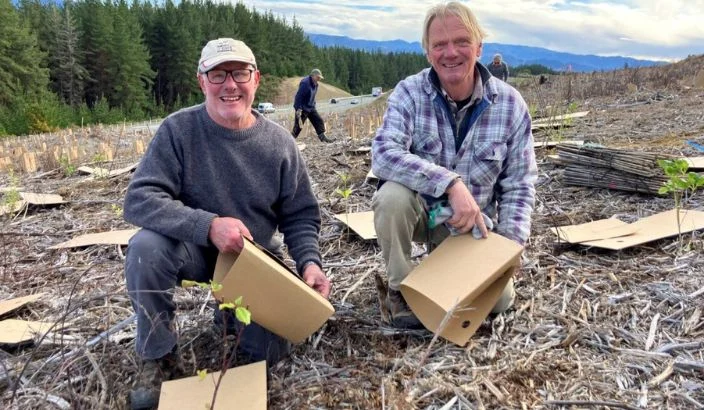
A major community planting effort has hit a significant milestone, with 11,500 native trees planted this season and a total of 35,250 trees put in the ground over the last three years.
Te Mamaku Native Corridor Project leads David Short and Michael Markert credited the achievement to the dedication of their volunteers and backers.
“Thanks to all of you that have helped us reach this landmark moment, coming out on these cold mornings to get the job done.”
Michael highlighted the collective nature of the effort, acknowledging support from generous donors, local businesses, and additional funding from Rātā, Lottery Environment Bank and Heritage, NBS Bank, Tasman District Council, Network Tasman, NZMCA, and Pub Charity.
David reflected on the progress, saying they were “still blown away” by what the team had accomplished.
“We’ve achieved something amazing, and we want to keep the momentum going.”
Among the highlights was the planting of 250 pōhutukawa, which will become a striking visual feature in years to come.
“What’s going to be really special is that in 30 years’ time, when you drive down the highway in December, you’ll see those pōhutukawa in full red bloom,” David says.
While this year’s planting is now complete, the focus shifts to maintenance.
Preparations are also underway for the 2026 planting season, which is expected to include support for planting within the neighbouring Tahimana subdivision.
The project is now estimated to be about three-quarters complete, with the ultimate goal of creating a thriving native forest corridor linking the Moutere Inlet to the Waimea Estuary.
The corridor will serve not only as a sanctuary for birds and insects but will also enhance the Dicker Ridge community walking and cycling track. The success of the 2025 planting season was made possible thanks to generous contributions from various supporters.
This included 7,500 trees funded by the Jean Malpas Estate Environmental Trust through Perpetual Guardian grants, 4,000 trees provided by Trees That Count, and 250 pōhutukawa donated by Titoki Nursery.
Volunteers also trialled 250 sheep wool weed mats, and plant guards were made available with support from the Lion Foundation.
A celebration is planned for November to thank everyone involved, while planning and fundraising for the 2026 season is already underway.
“Milestone achieved — but not completed,” David and Michael conclude.
