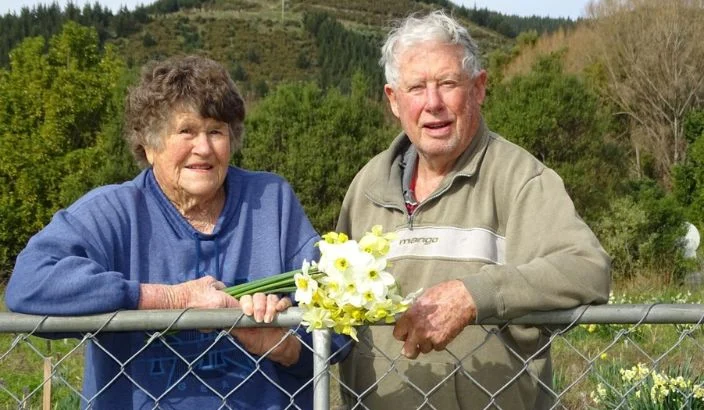
John Hunter is nudging 90 and still exporting some of the daffodils he has bred which are the latest of about 200 registered cultivars he has produced in the past eight decades.
This is his last year exporting new daffodil varieties though, with the help of his wife of 67 years, Marie, who fortunately loves daffodils too as she has spent endless hours hand weeding their Hope plot.
Just last week they heard from a Dutch client who said one of his earlier daffodils from a “breeding experiment”, Hunter Morn, was finally on the market and selling well alongside his Polar Hunter variety.
Obsession is the word John happily describes his association with daffodils over the years, driving him to develop “thousands and thousands” of new cultivars in a hobby that began when he was just nine.
“You have to be obsessive to grow them – but then to do anything well you have to be obsessive.”
His great grandfather, George Cook, grew daffodils commercially on the land that is now Cooks Reserve at Riwaka and his mother’s family grew them, so it was not surprising that John had a love for them at an early age.
He spent his working life as a fifth-generation watchmaker and jeweller in Nelson and says that probably taught him to be patient and thorough when it came to breeding daffodils because it takes five years to take a new cultivar from seed to flower.
“It has to be well thought out, to put the best genetics of one flower with the best genetics of another.”
Much of his success has stemmed from his decision to breed a new range of cultivars from a primitive Moroccan daffodil that looks nothing like today’s flowers. It was autumn flowering, which he says all daffodils were once, and it had double the chromosomes.
“Everyone was saying I was wasting my time, but I put new genetic traits into the daffodil that we had never seen before.”
It’s that kind of success from delving into the chromosomes of daffodils that earned him the highest award for growing daffodils from the Royal Horticulture Society in London in 2012, which he considers the pinnacle of his bulb-growing hobby.
Experimenting with the genetics of daffodils has given both of them huge pleasure over the years, including the anticipation of finally seeing the flowers on a long-awaited breeding journey.
“When you’re breeding them, you see evolution happening before your eyes.”
When there’s a success and an overseas bulb company buys the variety, there’s always been the necessary sterilisation of the bulbs, the 100 soil tests of their plot and a new name to be coined. It has been hard work, but Marie says it has also given them huge pleasure over the years.
The beds of daffodils are not as weed-free as they used to be but the passion for the flowers and their breeding hasn’t changed, and a visit is a history lesson in daffodils, their genetics and the long journey from a seed to a new flower in a distant country.
