
ROBYN PARKES
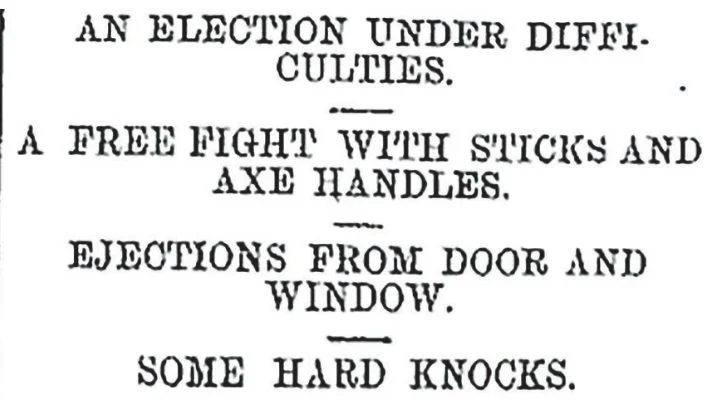
One would think that electing a school committee would be a simple process and would be completed in an orderly manner. But in Motupiko during the 1890’s this was not the case, and the extent of the fracas made news all over the country.
In 1894, tensions between Robert Thomson and the schoolteacher Harrison Evans began to bubble. As a result, Robert, along with friend W. Quinney, withdrew their children from Motupiko School and sourced exemption certificates.
Two factions developed in the settlement, those who supported Harrison and those who did not. Robert called for Harrison’s resignation and, although being loathe to interfere, the Education Board agreed to investigate.
Robert’s allegations of mismanagement included: children using insulting language to people passing the school, closing the school on a wet day despite children turning up for school, children searched when money went missing and forcing a child to search another child, unsatisfactory standard pass rates, keeping an open fire lighted in defiance of committee notice, refusing certain children to use the school gate, punishing them when they did, and lastly, for keeping money, stamps and mail in the schoolroom to the detriment of children. This despite Harrison being the postmaster, which was run out of the school.
The investigation exonerated Harrison of all charges. Robert then sued him for slander but lost the case. Feelings were high and came to a head in April 1897 at the next annual committee elections. Around 30 householders gathered, and trouble started almost immediately.
The meeting was advertised to start at 8pm, but the opposing faction began before this time, electing W. Gibbs to the chair. Objections rang out that this could not happen until 8pm so exactly at that time the ‘for’ faction elected Frederick Mead as chairman. Gibbs’ party continued and elected four other men as members of a new committee, F. Brewerton, Thomas Quinney, F. Gibbs and Robert Thomson.
The ‘for’ faction elected their own committee members, R. Coleman, A. Coleman, Hubert Mead, William Mead and Fred Mead Jnr. At this point things turned ugly. Gibbs ordered the room to be emptied so his committee could continue in their business. Suddenly one of his men handed out pick handles to five others and proceeded to eject anyone against them out of the schoolroom. Scuffles and fists ensued, and a full-blown fight began.
Reports showed that, allegedly, Robert Thomson approached Harrison Evans and seized him by the throat, then threatened him and dragged him about the room. Friends attempted to rescue him, but the door was barricaded. Constables arrived at the scene and, once getting the door opened, found Harrison sitting on a box, shaken and unable to get up, having sustained other injuries. The Education Board, on learning of the fiasco, declared the elections to be void.
Robert Thomson, L. Thomson and Thomas Quinney were charged with assault and found guilty. Tensions remained high and all were anxious when the next elections came round. Constables were sent to Motupiko to stop any trouble. However, instead of fists and pick handles, ‘miner’s rights’ were used by the Gibbs-Thomson party, blindsiding many of the householders.
Gibbs was voted chairman and he, along with Frederick Gibbs, Alfred Coleman, Frederick Brewerton, William Gibbs and Thomas Quinney became the new committee.
How did this happen? By studying the School Committee Elections Act, they found a clause that allowed ‘miner’s rights’ to be used in local elections. This allowed for non-voters, women and children over 14 to hold ‘miner’s rights’, qualifying them to vote in a school district if they lived within a proclaimed mining district and had been resident for three months. Sixteen individuals were helped to take out ‘miners rights’ just before the school elections. The meeting was closed when accompanied by some rowdyism and shouting.
