
ROBYN PARKES
The Kawatiri railway section was beset with delays. Work began in December 1912, stopped in April 1913 due to a lack of funds and resumed in November 1914.
However, because of the demands of the war, manpower gradually reduced until work stopped again in February 1917. At this time a caretaker was appointed to maintain the site until work could be resumed.
In 1918, the establishment of a school was requested by settlers and a temporary school was approved in 1919, but it was not until April 1921 that a proper new school opened.
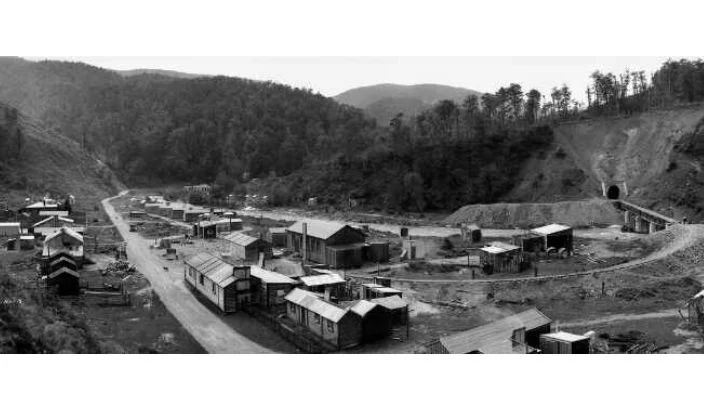
Work began again in 1920 on the Kawatiri tunnel using men based at a new construction camp at Woodhen Bend. Initially there were only 30 workers to undertake the task of constructing a tunnel of 185 metres plus approach bridges at either end, and to divert the river into a new channel.
A Workers Union was established at the camp in late 1920 and they approached the Hospital and Charitable Aid Board to form a benefit society in connection with the hospital to entitle them to its benefits. It was agreed that each man could contribute one shilling per week which would ensure they would only be charged two shillings per day while receiving hospital treatment.
More workers arrived until eventually there were around 300 people in the camp. In 1921, the Pikomanu Post Office was opened, and this became the official name for the settlement.
Camp life settled into a routine of regular sports events, giving some balance to the rigours of the work. The first of an annual sports day was held on the 24th of October 1921 (Labour Day) at ‘Telegraph Flat’ with events for men and women, the more popular being the races, wood chopping, tug of war and side shows.
The first annual school Christmas and prize party took place in 1921, only a few months after its opening. Teacher, Mr L. Ford, was praised for the improvements in the children’s schoolwork and knowledge.
The tunnel was in full swing in 1922 with three shifts working each day, overseen by E. H. Birchall, and was completed in 1923 meaning some from the camp were shifted to the Gowan section. Sports teams were inaugurated, these being a tennis club and cricket club, the latter winning the local shield.
A recreation hall was built with dimensions of 50 feet long by 25 feet wide. The opening took place with a dance organised by the workers and Milligan’s Orchestra coming from Murchison to supply the music.
About this time Mr J. Reed took over the local canteen and opened a store, bringing the total of stores to three.
A sub-branch of the Plunket Society was formed in September 1925 to obtain the services of a Plunket nurse to visit the area every four weeks. Each member was levied 5/- per annum to offset the nurse’s salary.
With the men involved in some dangerous work there was always a high risk of accidents. In April 1926 David Coghlan was hurt while placing a percussion cap into a charge of dynamite which exploded and blew off his right hand. In May, Dan Leatham sustained very bad bruising from falling earth and in July, G. Rich had a narrow escape as he was warming up a plug of gelignite when it exploded.
With a reduction in the number of children at Pikomanu, the school was closed in 1926 and the school building was relocated to a new site near the Gowan. By January 1927 the whole of the camp had been transferred to Gowan and with this came the death of the close-knit Pikomanu community.
