
ROBYN PARKES
In the Motueka district, changing times and opinions created an uncomfortable tension between education and the needs of the industries within the district.
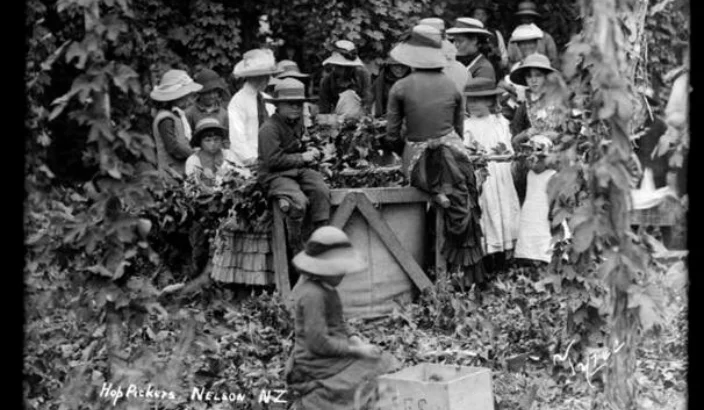
For many years children assisted in the gathering of the hop harvests which meant they were absent from school for up to four to five weeks, after only just having completed five weeks’ holidays over Christmas. What was once acceptable was now questioned.
In 1901 the new School Attendance Act came into being which enabled pressure and fines to be brought on parents who were neglecting the education of their children. The Act included required attendance rates for children between seven to fourteen.
School committees had some discretionary powers to decide on when schools would be open or closed, and in January 1902 the Motueka School Committee met with the public to discuss the issue of schools closing for longer periods due to the absenteeism of large numbers of children.
So started the struggle between the education of children and the commerce of the district. Some believed the schools should stay open while others believed it was a great hardship to enforce compulsory attendance during the hop season when families could make extra money.
The Act did not recognise fruit or hop-picking holidays, or any other form of child labour.
In October 1902, George Hogben, Secretary for Education and Inspectors, visited Motueka to investigate the local conditions concerning the adverse influence of the hop-picking season on the attendance at schools in the district.
Mr Rankin of Motueka advocated for the absolute necessity of children for picking for the prosperity of the district, but admitted that it lowered the educational standing of the schools.
Over the ensuing years the problem remained, and tensions grew as both sides battled for a solution. In 1916 the Nelson Education Board considered a report concerning hop-picking holidays, stating incidents where an alarming increase of holidays were being taken. One school in Motueka reported that during this time less than 50 percent of the children were attending.
The Board reacted, notifying School committees that any deviation of holidays due to hop- picking must be made through an application to the Board for approval, but even if granted would be limited to two weeks.
Many hop growers were angry that the children may no longer be available to help with crops and others stated that hardship would result for both the families and growers.
The issue took on a larger focus of not only children being absent from school but also that of child labour.
In 1922 the Education Board were presented with a report by Senior Inspector, G. Pitcaithly, who stated - “the ill effects of the current irregular arrangements are evident right throughout the districts, including Motueka, where the education of children is made subservient to the industries.
The continual stopping and starting of schoolwork is harmful and it is a question as to whether the education of the pupils or the scandalous problem that at a time when unemployment is rife that those engaged in the industry should endeavour to make conditions worse by bringing in child labour.”
Pitcaithly recommended that the district’s holidays be standardised and finished with a statement for consideration - were the schools to be run in the interests of education or to further an industry.
The Education Board took the recommendation and resolved that standardised holidays going forward would be two weeks at the end of terms one and two, each of 14 weeks long, and five weeks at the end of the third term (Christmas).
