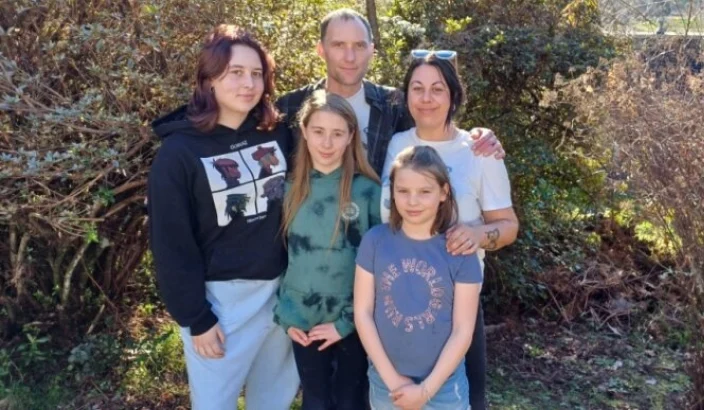
The Ngātimoti community has rallied around a local family which is navigating a terminal brain cancer diagnosis.
When Stacy Douglas first started complaining of tiredness, headaches and forgetfulness, the factory foreman and his family assumed it was a matter of lifestyle, not health.
“Through the day I [was] struggling to do things,” the father-of-three says, thinking back to April when the symptoms first started. The family blamed it on late nights, on work stresses, on turning 40.
After a few weeks of worsening symptoms, Stacy popped out of work to visit the doctors and the results were shocking.
He scored just five out of a possible 35 in a cognition test, and the doctor insisted that he be driven straight to the hospital’s emergency department – steel caps, high-vis and all.
A CT scan revealed a brain tumour, and the Christchurch histology department diagnosed grade four astrocytoma.
“One of the worst,” says Stacy’s wife Bex, who is always by his side, caring for Stacy and filling in the gaps when his words don’t fall into place quite like they used to.
“That’s the fastest growing, and the worst one to have.”
Stacy had a craniotomy to remove the cancer, but due to the risks and tumour placement, the surgeon was not able to take it all. Within weeks, it had grown back even larger. A second surgery also failed to remove it – an attempt to get the final sliver, which was on a main artery, caused Stacy’s heart to stop for over a minute.
The second surgery took its toll on them both, Stacy as the patient and Bex as his 24-hour nurse.
“Our bodies were already pushed to the limits of tiredness and exhaustion.”
They have travelled to Christchurch, where they will remain until mid-September, for Stacy’s radiation and chemotherapy. Their children have remained at home with family, to keep them in something of a normal routine.
The prognosis is bleak on paper – at one year, this type of cancer has a 50 per cent survival rate, reducing by a further 50 per cent in year two. After that, the statistics are too patchy for the doctors to cite.
“Stacy says he’s doing 10,” Bex says with a laugh, “and I’m going with that, so that would be wonderful.”
Their faith gives them strength and a semblance of serenity, Bex says.
“The art of distraction is good. Learning to be in the moment and just going for walks in the sun and doing the little things.”
Stacy adds that he sees the prognosis as a sort of blessing. Tomorrow is never a given for anyone, but he feels lucky to have been gifted the chance to spend quality time with his family, make memories, and discuss the details of life and death.
He plans to use his time to get the property – an 1896 villa on a lifestyle block that they fell in love with a decade ago – to a good standard for Bex and their daughters.
A Givealittle page has been established to help the family navigate some of these expenses, which have a sudden urgency that was not there before.
They also have additional medical costs to absorb, and all without Stacy’s wages.
They have been hugely buoyed by the outpouring of love and support from the Ngātimoti community, which has been their home for 11 years. A recent fundraiser at the Ngātimoti hall saw about 400 people in attendance, which “blew my mind”, Stacy says.
The couple is used to being the valley’s social hub – over and over, they have thrown open their doors to friends and strangers, and a great many locals can attest to having been to one of their epic parties.
This time, it was their turn to receive.
“I’ve never been to an event that was so filled with love,” Bex says.
Stacy’s first craniotomy came almost two years to the day after Bex had an anaphylactic reaction to an antibiotic that left her paralysed from the waist down, with a gruelling six-month recovery while she relearned how to walk. Then, too, the Ngātimoti community provided strength and support.
At their low moments, Bex says, it does feel like they have had more than their fair share of knocks, but “you get to a point where you’ve just got to laugh about it”.
“I mean, who can you be mad at? There’s no one to blame for any of this stuff,” she says, adding that it is about the way you look at it.
“What he said before – how amazing is that attitude to have? How was I blessed to get someone so amazing?”
The Douglas’ Givealittle page is givealittle.co.nz/cause/help-the-douglas-family-get-through-another-big
