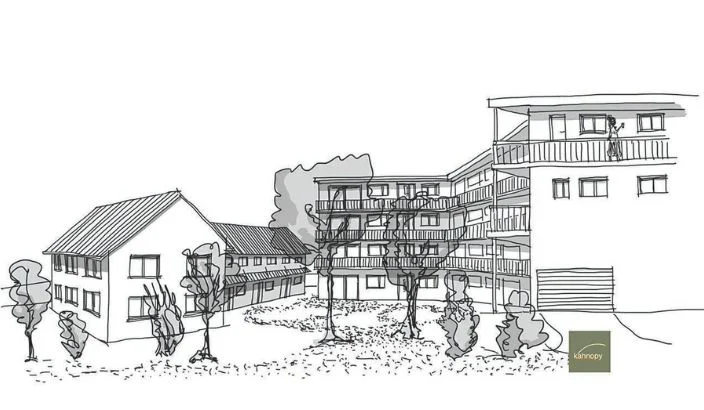
A property development company that built a cohousing project in Tākaka is launching a campaign to raise capital for more cohousing neighbourhoods around the country, including one in Tāhunanui.
Circle Living plans to deliver 200 homes between eight cohousing neighbourhoods across the country over the next five years and the Tāhunanui project, which will have between 35 and 40 homes, is tagged for completion in 2028.
To achieve its goal, the company’s equity crowdfunding campaign launched this week aims to raise a minimum of $385,000 that will be used to identify prime land and assess the feasibility of projects across the country.
One of the three cofounders, Vincent Revell, a development manager and civil engineer from Māpua, says there is a demand for cohousing, and the company wants to be the housing developer to do it. But it needs the funds to viably go forward.
He says cohousing is simply tweaking the conventional way of living to create a better neighbourhood. It does that by limiting all parking to the side of the development to free up land within the neighbourhood, creating common facilities where the community can gather, and building the community.
“We build the community during the presale process, so by the time the housing is ready, the people already know their neighbours.” A site for the Tāhunanui cohousing project has been located, but he says it has not been secured yet.
More details about the project, known as the Tahunanui Collective, will be talked about at the local crowdfunding campaign launch being held in Nelson at the Mahitahi Colab on Thursday evening. The campaign is being launched around the country and will run for a month, with a third of its target already achieved, Vincent says.
“A big part of the model is partnerships; partnering with like-minded people.”
At this stage, cohousing is still a niche product, making up about five per cent of the housing market in New Zealand, but he says it provides a better social outcome.
The company’s first project in Tākaka created 34 homes at a cost of $26 million. Once the company has identified land and assessed feasibility, it intends to raise $10 million through wholesale investment loans to purchase land.
