
ROBYN PARKES
The ports of Golden Bay were vital in the early days of settlement, linking small and remote communities to the outside world. By late 1857 Collingwood was a small village with houses, stores, huts, tents and new buildings springing up.
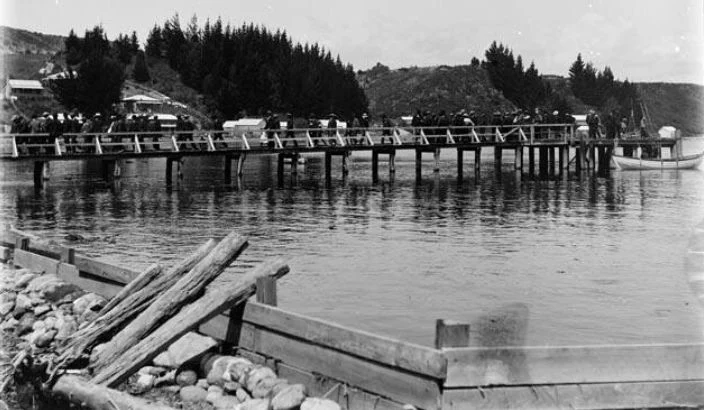
A wharf was under construction, relieving the problem of ships having to remain further out from land and having to unload cargo and passengers through using smaller boats. Larger vessels had to wait outside for the wind and tide to carry them into the harbour.
With increasing trade and numerous vessels arriving due to the goldfields the harbour was declared to be a Port of Entry for the in January 1858 by the Government.
The wharf was a busy place that required ongoing upkeep but by May 1895 attention was drawn to its dangerous and dilapidated state. One seafaring man declared that ingenuity and agility was needed to negotiate the chasms and cavities over the wharf. The previous week one of the main stringers broke, giving the structure a list to port and increased the difficulties of navigation. Around 1908 improvements were called for with a proposal to construct a new wharf in deeper water. This was not achieved until 1918.
In 1929 the Marine Department produced an Order in Council vesting the management of the wharf in the council for a further 14 years term but advised that as the Council collected all wharfage’s the Department would not undertake any further liability for the maintenance of the Port.
It was resolved that the Council make an application to be vested with the powers of a Harbour Board.
By the 1930’s the problem of sand lodging in front of the wharf had become serious and at times rendered the port unworkable. Men were frequently employed to level the bank to permit boats working at high tides. Around 40 yards of large boulders were transported across the stream to the overflow channel where groynes were built and wattling placed. It was hoped that as the engineers widened and deepened the boulder bank an increase in water would be brought down and the sand nuisance eliminated.
By November 1940 the harbour was operating at a loss, showing an income of £396 15sh 3d, and expenditure of £437 13sh 5d. Collingwood Council and residents met to discuss how to increase the use of the harbour and restore the shipping service. More goods were being transported by road, contributing to the decline in usage.
In the previous year up to five ships were operating in Golden Bay but three were requisitioned by the Government, leaving none to operate directly from Wellington. The remaining ships opted to work from Waitapu wharf due to the Inspector of Shipping ordering that no vessel was to work a harbour if it had to be on the bottom during working. This was the case in Collingwood where the outer harbour lacked good berthage space and was said to be a failure.
The Collingwood Harbour Board considered the issues and possible remedies including possible harbour improvements of shipping facilities, which boat service was desired, the question of an extension of the old wharf, or the construction of a wharf at a new site. It was agreed that the outer wharf should be abandoned.
Attempts were made to secure a vessel to run the Nelson-Waitapu, Collingwood-Wellington on a regular basis. In 1947 the Collingwood Harbour Board was dispensed with when Collingwood and Takaka County Councils merged. Today it is owned by the Crown and under the control of the Department of Conservation.
