
ROBYN PARKES
In the early 20th century, Scottish settlers across New Zealand formed Caledonian Societies — social and cultural groups dedicated to preserving their homeland’s traditions through Highland Games, dancing, music, and social gatherings.
Motueka’s own Caledonian Society was established in 1923, bringing a touch of Scotland to the region and creating an enduring local tradition.
The Society’s first event — the district’s inaugural Scottish concert — was held that same year in the Horticultural Hall, embodying the spirit of Scottish celebration.
The evening began with a lively parade by the Pipe Band along Motueka’s main street, followed by the old custom of “first-footing” on New Year’s Eve 1923.
In Scottish folklore, first footing marked the first visitor to enter a home after midnight on New Year’s Day — believed to bring good luck for the year ahead. A dark-haired man was considered especially fortunate, while fair-haired or female visitors were thought to bring bad luck.
The night culminated in a grand concert on New Year’s night, with the hall beautifully decorated in ferns, Scotch thistles, and heather.
The event was such a success that organisers vowed to make it an annual celebration.
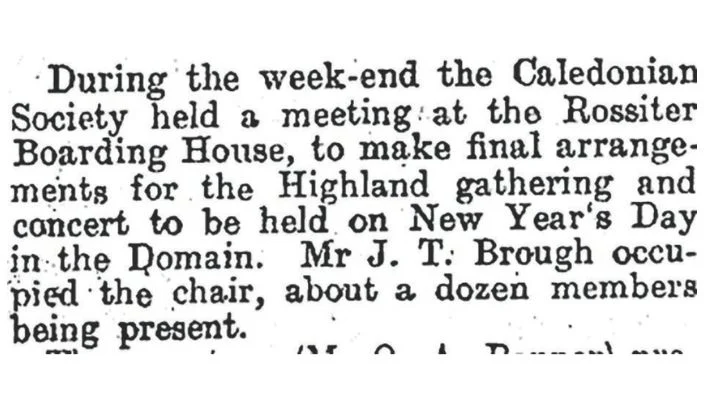
The following year, Society member Mr J. Brough requested the use of the Domain Grounds for a picnic and Highland competitions. Permission was granted, with the condition that the closure be advertised ten days in advance and that an entry fee not exceeding one shilling per adult be charged.
The first Highland Gathering took place on New Year’s Day 1925 and proved a resounding success.
Spectators gathered early to witness the gathering of the clans, with the Blenheim Pipe Band travelling to Motueka for the occasion. The band was billeted in local homes and welcomed with a civic reception by Mayor J. McGlashen.
On the Wednesday night, they performed in High Street, drawing a large crowd.
Pipers from Nelson and competitors from across the district arrived the next morning, ready to take part in music and dance competitions — including bagpipe marching, Highland fling, seann triubhas (a dance said to have developed after the 1745 Jacobite rising), sword dance, Irish jig, and hornpipe.
The day concluded with another well-attended concert and a profit of £45.
Buoyed by this success, a meeting was held in May 1925 to plan the next New Year’s event.
Secretary O. Banner reported that during a visit to Wellington he had met Mr Nimmo, Chief of the Wellington Caledonian Society, who offered his assistance to help formalise the Motueka group.
It was resolved — on the motion of Dr Bathgate and Mr Ingram — that the Society adopt the Gordon tartan and that the Motueka Caledonian Society be officially incorporated.
True to their word, the Society went on to host annual Highland Games and concerts, as well as other public events that became highlights of the local calendar.
In 1940, a special Centennial Highland Gathering was held — 16 years after the Society’s formation — attracting hundreds of locals and visitors to Centennial Park, where the sound of pipes and drums once again echoed through Motueka.
