One of the most biodiverse places in the country is right on our doorstep, and its caretakers have compiled a 300-page love letter in its honour.
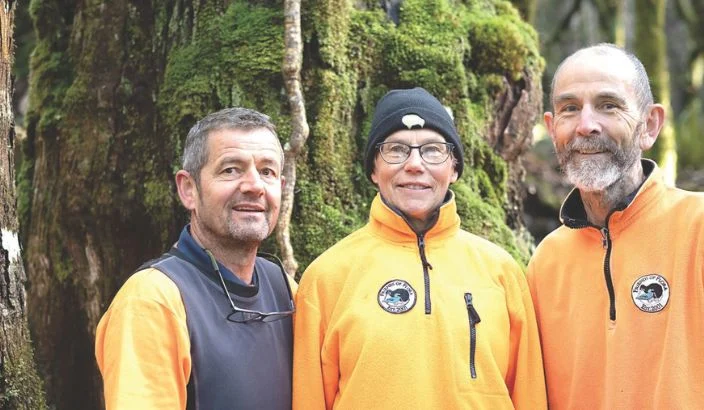
“Caring for Kahurangi – The inspiring story of Friends of Flora” is a collaboration by Sandy and Robin Toy and photographer Ruedi Mosimann, and contains the voices of many of their fellow FoF volunteers.
“It’s not our story,” Sandy explains. “It’s the story of so many people, really.” The book tells of the hard-fought wins and devastating losses in the conservation group’s battle to protect the flora and fauna of the 10,000-hectare Flora Stream catchment area within the Kahurangi National Park. The group, which works in partnership with the Department of Conservation, was established by Maryann Ewers and Bill Rooke 25 years ago, and currently has 50 volunteers. Robin and Sandy joined their ranks in 2010, and Ruedi came on board about two years later.
The book begins by telling of the Toys’ joy at finding the first Flora-born roroa/great spotted kiwi, and Sandy says that the species’ re-establishment is one of highlights of her FoF involvement.
“She was so glossy and beautiful,” Robin says of the roroa they named Hebe.
“They’re tricky birds,” Sandy says fondly. “They’re really sly and coy, and they breed incredibly slowly. It just feels like one step forward and half a step back.”
However, heading into the Kahurangi and hearing a duet between a pair of kiwi is a marker for what FoF has helped achieve. “I think, wow, that wasn’t possible 25 years ago,” Sandy says.
The reintroduction of whio, or blue ducks, was another flagship project for FoF, with the population dwindling to a single bird by the turn of the century. Seven years later, the first ducklings fledged successfully, and now, the Flora creeks and side streams are abundant with whio. The couple, who are both ecologists, head into the Flora about twice a week, although they also spend “a lot of time doing organisational, boring stuff”, Robin laughs.
Access has been tricky after the floods, but the volunteers are still managing to maintain their monitoring and trap lines – albeit slightly less frequently than they would usually be able to.
The trapping is a huge weapon in FoF’s arsenal, with rats, mice and stoats presenting a devastating threat. Wasps, goats, deer, possums and wild pigs also need careful management, and then there is also the looming shadow of feral cats and ferrets, both of which can take out an adult kiwi. Sandy says they must constantly adapt their strategies to stay ahead of the threats.
When asked about their favourite FoF activity, Robin says he likes the “challenge of the hunt”.
“It’s a bit nerdy – it’s looking for and counting caterpillars.” His most treasured creature in the catchment is the pīpipi, or brown creeper – a tiny bird endemic to the South Island.
“It has this lovely descending call that just tickles me,” he says. “It makes me smile.”
Sandy’s is a little less cute, at least in the traditional sense. “I would think mine would have to be the Mount Arthur giant wētā. It’s a gorgeous wee thing, and for a giant, it’s pretty tiny. It only weighs seven grams.”
They can envision the land as it was 150 years ago, with many more birds, and “clouds of moths at night”. Much has been lost – but Sandy also points out just how much has been reclaimed. “If you compare it to 25 years ago, it’s so much more wonderful than it was then.”
The book is being launched at the Motueka Library on 15 October, 6pm. RSVP at pauline@potton andburton.co.nz.
