
ROBYN PARKES
William and Anne Brereton’s introduction to life in Nelson was one of terrifying proportions.
They arrived around 1876 with four children and two sisters of Anne’s, Letitia and Eliza. Shortly after arrival, they were lodging in a house belonging to Mr Lloyd and, on waking one morning, found that the house was flooded and water was all around them.
For most of the day, the family endeavoured to cross a paddock by travelling from stump to stump in order to get to higher ground.
Mr Lloyd was eventually able to reach them all and remove them to another house. On his last trip, with a Brereton child and one of the sisters, the horse fell and all were thrown off, narrowly escaping drowning.
The family quickly settled into country life in the Pokororo settlement. William was elected to several boards including the School Committee in 1880 and the newly-formed Ngātīmoti and Pangatotora Road Board, and was also involved in local church matters.
In total, nine children were born to William and Anne with all but one living to a good age, these being Ann, John, Matilda, Cyprian, Mary, Thomas, Helen, Allen and Constance. The children received their early education at the Pokororo school and by all accounts were good and hard-working students.
Cyprian and Matilda gained scholarships while at the school, but the achievement was questioned by some as to whether William had had a hand in it.
This gossip was quickly put to rest through a strongly worded letter to the newspapers that the achievement was made purely through the skills of the teacher and the intellect and hard work of his two children.
Cyprian went on to have a very successful military career. Matilda, in 1891, became a probation teacher at Pangatotora School and four years later was appointed to the teachership at Woodstock School.
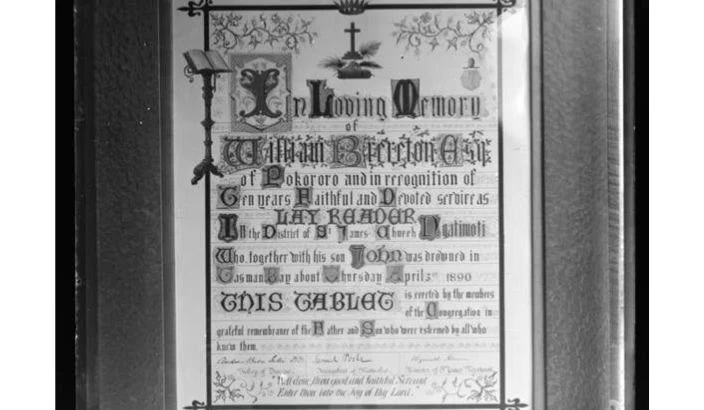
Tragedy struck the family in late March 1890. William and eldest son John, aged around 17, left Motueka on the 31st in a homemade catamaran for a fishing trip to Astrolabe.
The intention was to return on the Friday, but by Sunday there was no sign of them. A message was sent to the Motueka wharf confirmed the boat had not returned.
Local men Deck, Lloyd and Knowles began a search from Kaiteriteri, spreading out to Torrent Bay, Awaroa and Totaranui, but had no success.
A sighting was confirmed by a man who saw a boat off Marahau on the Thursday, heading for Motueka in fine weather.
A two-day search ensued of any spot where a boat could have landed, but with no leads all hope was abandoned.
On 17 April, news was received that a canoe-like boat had been found on the east side of Abel Head, being about 22 feet long, plank and batten built, the outside painted with hematite with black and white ribbons of an inch and a half.
Wreckage of another canoe was found close by, the two forming a catamaran. The bodies of William and John were never found. Their names are memorialised on the Brereton headstone in Waiwhero Cemetery.
Anne remained on the family farm and passed away in November 1915.
