
ROBYN PARKES
In May 1943, the Waimea Boys’ and Girls’ Agricultural Clubs’ Association was formed to give local children a deeper understanding of farming and country life.
The initiative brought together farmers, school representatives and other community organisations, with the aim of teaching children practical skills in crop production and stock rearing, while fostering cooperation and a love for rural living.
The clubs were organised by local rural bodies and controlled and directed apart from the schools, although the cooperation of the schools was needed. The members were the children who attended the various primary schools and every school club had a committee and secretary. The scheme offered an opportunity for a child with non-academic aptitudes to take part in the school activities.
In each participating Waimea school, an appointed executive was the local supervisor, usually a farmer member of the school committee, whose duty it was to advise competitors, to watch over their interests, and to see that the materials needed were distributed and that rules were obeyed.
These local supervisors also helped to maintain the interest of the parents of each child.
Between the months of May and July 1943, every school in the Waimea district was approached to help the children in forming their own school club.
The idea was that the children organised their own club activities in their schools, conducted their own meetings, and elected a president.
A general committee from among the school children was set up and a business-like procedure adopted with minute books being kept. Each local area had several adults who were available to advise and encourage the children.
They also completed the preliminary judging for some of the competitions and then assisted the general supervisor.
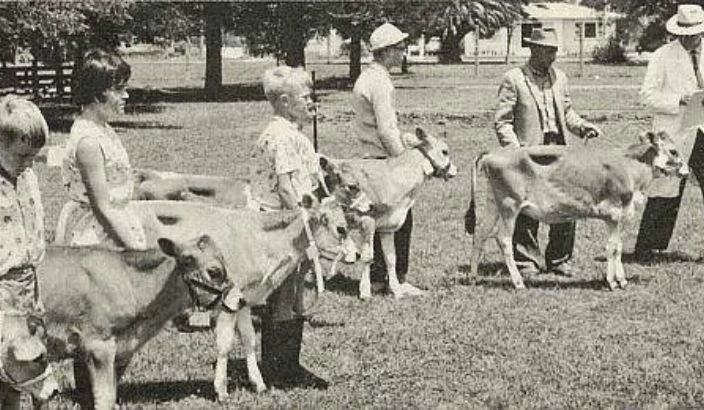
There were several types of competitions with the first being the rearing of a calf or pet lamb. The children took a calf when very young, feed and cared for it and kept a written record of its health, feeding, special treatment, etc., and of the cost of the rearing.
Growing of field crops involved cultivating a plot of 16 ½ feet by 16 ½ feet. Points were given for cultivation, the quality of the crop, and the yield of the various vegetables including carrots, mangolds, swedes, sugar beet and potatoes. Final points were given for the quality and depth of the notebook in which each child kept a record of crop process, including cost.
The vegetable competition plots had to be of 150 square feet and points were given for cultivation, interest, quality, arrangement and note taking. Within these plots, carrots and silver beet were compulsory.
Cups, trophies and certificates were donated by various groups, companies and associations.
In the first year’s competition the Waimea schools of Foxhill, Brightwater, Neudorf, Hope, Appleby, Upper Moutere, Redwoods Valley, Spring Grove, Wakefield, Richmond, Pigeon Valley, Ranzau and Dovedale had a combined number of over 255 entries. Appleby School was noted and congratulated for having a number of wins in the various section competitions.
As the 1943 competitions wound up, it was pronounced by Mr W. Dron, president of the Waimea Association that there had been some misgivings around the possible level interest in the scheme the Association, had been rewarded with results exceeding their expectations.
