
ROBYN PARKES
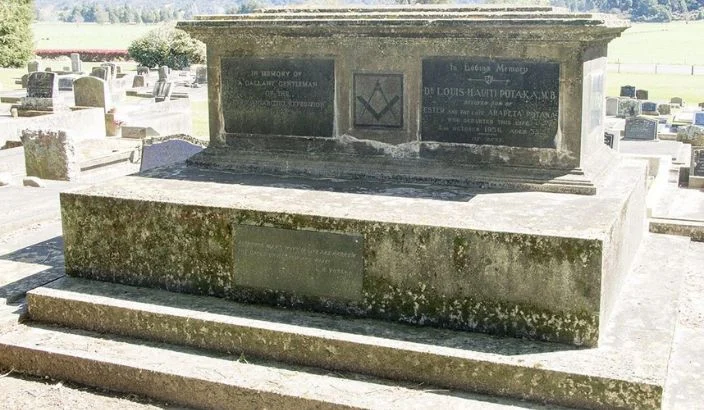
In Rototai Cemetery stands a large monument to Louis Hauiti Potaka, a young Māori doctor remembered for his role in the Byrd Antarctic expedition.
The inscription reads: ‘In memory of a gallant gentleman of the Byrd Antarctic expedition’ and below it, ‘Although man’s ways in life are narrow, the gates of heaven are wide.’
Potaka died in tragic circumstances in Tākaka on Friday, 2 October 1936, aged just 35. So, who was this young man?
Born in 1901 to Esther, of Welsh descent, and Arapeta Tapui Potaka, Louis chose medicine as a career. He studied at Otago University, completed his internship at Nelson Hospital, and graduated in 1930 with a Bachelor of Medicine and Surgery.
His first posting was a three-year term in Murchison, earning £250 a year. He arrived in 1930 as the township was still recovering from the earthquake, and quickly became popular for his tireless work. Just three months later he left to take up another position, but told the local council he would return if a suitable house was provided under his agreement.
Louis returned to Murchison in June 1930, but the relationship with the council was strained and exacerbated by an argument over his residence. Despite a petition with 650 signatures calling for him to stay, the council demanded his resignation. Louis refused, and was given a letter of dismissal.
He returned to Nelson Hospital as a house surgeon, but in early 1934, a rare opportunity arose. Louis volunteered for the Byrd Antarctic expedition. While in Antarctica, he suffered snow blindness and used cocaine drops for their anaesthetic properties to treat it. Prolonged use damaged his eyes.
On his return to New Zealand, he took up a locum role in Tākaka in mid-June 1935, covering for Doctor Bydder’s private hospital.
Bydder had given Matron Sister Hyland power of attorney and a financial interest in the practice. She and Louis clashed almost immediately. She was older and more experienced, and the tension may have stemmed from resentment - or from Louis being young and Māori.
Bydder was told the practice was at risk and returned unexpectedly. He dismissed Potaka, citing issues with the Matron and concerns that Louis was trying to start his own practice.
Again, locals rallied behind him, signing a petition in support stating that they were happy with his services and wanted him to stay.
But Bydder reported him to the Nelson Division of the British Medical Association for starting his own practice on the basis that it was unethical, and in June 1936, he was ordered to shut his practice. He chose to fight the decision.
Louis was by now in a low place, worrying about the case and the problem with his eyes which could end his medical career.
He confided in friend David Mason about his exhaustion and worries, staying with him for a couple of days.
On a drive to Nelson, Louis asked David to stop at the top of Tākaka Hill. Louis took the car and drove off alone. He was later found on Canaan Road, having taken a large dose of morphine. Though rushed to Nelson Hospital, he died shortly after arrival.
