ELOISE MARTYN
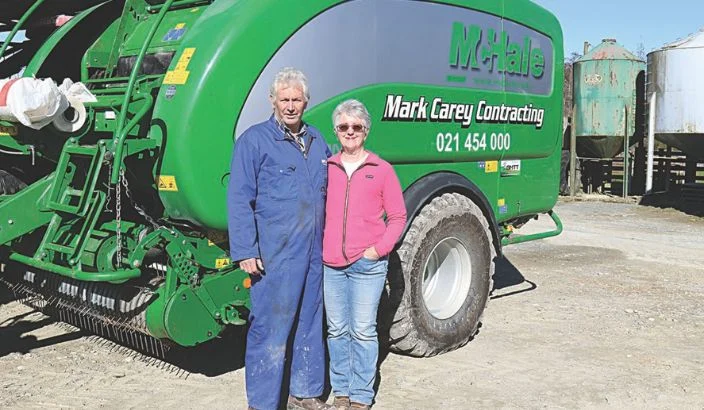
Growing up with dirt under their nails and stock in the paddocks, Mark and Anne Carey can’t imagine life any other way.
Together, they’ve built a livelihood from the land, Mark spending decades in earthworks and together rural contracting across the Tasman region. Mark, raised on a rural block in Rosedale, left school at 15 to work on the family farm which included harvest contracting on neighbouring farms — “It’s all I’ve ever done,” he says with a smile that says he wouldn’t have it any other way. Anne grew up on a mixed farm in Canterbury. Their shared love for rural life led them to a career helping others get the best from their land.
The Nelson-Tasman region has transformed significantly since they began. Dairy paddocks and sheep farms have given way to grapevines, hops, and apple orchards, with fewer large farms and more lifestyle blocks.
“Some of the better land has gone into horticulture,” Mark explains. “It took time to build the right framework across different industries. We have a quieter spell in winter, but we’re busy almost all year round.”
One of the biggest shifts the couple has seen is the rise of precision farming. GPS-guided equipment now plays a key role in their operation, allowing them to plant with centimetre-level accuracy. Developing GPS precision planting technology for apples is an opportunity they’re both glad they pursued.
More recently, they’ve successfully trialled the same technology for planting hops and grapes. The system ensures perfectly aligned rows and spacing. Mark notes: “What you can do with it is amazing. You can plant an orchard straight, and the trees line up on 90 degrees as well.”
Anne adds: “We did more work with hops five to ten years ago. It’s quiet now, but we’ll be back when the market picks up.”
The most enjoyable part of their work? “When the team rolls out of a paddock that’s been harvested well — straight lines, clean edges — there’s a great sense of satisfaction,” they say. Problem-solving is another aspect they enjoy, whether it’s improving yields or managing pests. “Helping people solve problems is all part of it,” says Anne.
But contracting isn’t without its challenges. It’s weather-dependent and often high-pressure.
“Grass grows at the same rate everywhere,” they laugh, “so everyone wants us at the same time.”
Wet weather adds to the pressure, and when one thing goes wrong, usually three others follow. Like many in farming, they’re feeling the squeeze of rising costs.
“Everything’s gone up,” Mark says. “Machinery prices have skyrocketed since COVID, and so have wages, repairs, and fuel.”
Anne notes that while input costs keep rising, hay prices have stayed the same for years. “We can only get so much for a bale — it’s about the same as five years ago. Imagine putting the price up by a third, people wouldn’t pay it.”
Still, they take it all in their stride. With a trusted team of full-timers, Fred Ewers and Pete Blanchet and seasonal hands, Mark and Anne credit their crew with keeping things running smoothly. “None of this would be possible without our great team,” they say.
When they’re not working for others, they’re busy on their own land — hosting winter grazing for dairy cows, fattening beef, and growing maize grain for the dairy industry.
This season they won the Pioneer South Island Maize Grain yield award by growing 16.1 tonnes to the hectare. After nearly 30 years in the business, they’re not slowing down — but they are starting to look ahead.
“We’re not sure what the future holds, but we’re ready for a change soon,” they admit. They’re looking forward to attending the Pioneer maize conference in Australia in 2026. There, they’ll visit farms in Victoria and explore Tasmania.
At the end of the day, it’s not the machinery or business structure that keeps them going — it’s the connection to the land, the pride in a job well done, and the people they work with. From dairy support to lifestyle blocks, rolling hills to orchard rows, Mark and Anne Carey have spent their lives doing what they love — and it shows.
