
ROBYN PARKES
In the late 1880s, Richmond’s men took it upon themselves to create spaces for social connection, learning and recreation, launching two initiatives that reflected the township’s growing desire for community engagement.
The first of these was the Pleasant Sunday Afternoon Club, established in April 1888 by J. Harkness. Held in the Oddfellows’ Hall on Oxford St, the club aimed to provide local men with a relaxed and informal setting to spend their Sunday afternoons. The club’s mission was to provide a “pleasant afternoon” while also extending a helping hand to those in need of companionship or support.
Just a month later, in May 1888, the Richmond Working Men’s Social Club was formed. This initiative quickly attracted attention and interest from the community. Operating during the colder winter months from a building on Queen St, the club offered a range of activities. Members could participate in games, engage in lively debates, or spend time in the reading room, which was stocked with newspapers and periodicals. It was a place where men could gather, share ideas and enjoy a sense of camaraderie. However, despite its promising start, the club struggled to maintain momentum and was disbanded by 1891.
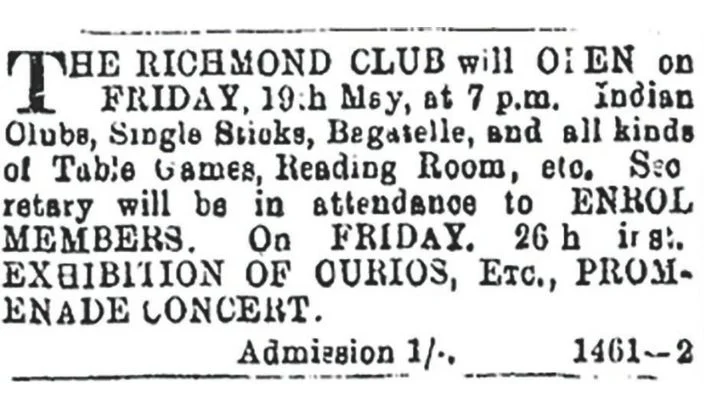
Not long after, a new organisation emerged to fill the void. In July 1891, the Richmond Club was officially opened, with considerable effort going into its launch. The presence of the mayor and councillors from the newly-formed Richmond Borough Council lent the occasion a sense of importance and civic pride. The club rooms were decorated with flags and pictures, and furnished with items loaned from the now-defunct Working Men’s Club, giving the new space a sense of continuity and familiarity.
Local resident Samuel Fittall was a strong advocate for the club, believing that in the absence of visiting theatrical companies or musical performers, it was up to the men of Richmond to create their own entertainment. The club opened its doors twice a week, on Tuesday and Friday evenings from 7pm to 9.45pm. In keeping with its values, the club prohibited gambling and card games, aiming to foster a wholesome and intellectually stimulating environment.
One of the most notable events in the club’s early days was a debate held in August 1891, which tackled the then-controversial question of whether women should be granted the right to vote. The topic sparked a spirited discussion. Those opposed argued that women’s education and natural inclinations did not suit them to the political sphere, and that granting them the vote would be unfair to men. Despite passionate arguments in favour of women’s suffrage, the debate concluded with a majority voting against the motion.
The club continued to expand its offerings. In May 1892, James Blair led the first singing lesson, attracting around 30 men. The club also began to open its doors to women, with several ladies later permitted to join a shorthand class, indicating a gradual shift in attitudes and inclusivity. Despite its promising start and the enthusiasm of its members, the Richmond Club appears to have quietly faded from public life after the 1893 season. No further mentions of the club have been found in local articles or advertisements, suggesting that it may have quietly disbanded.
