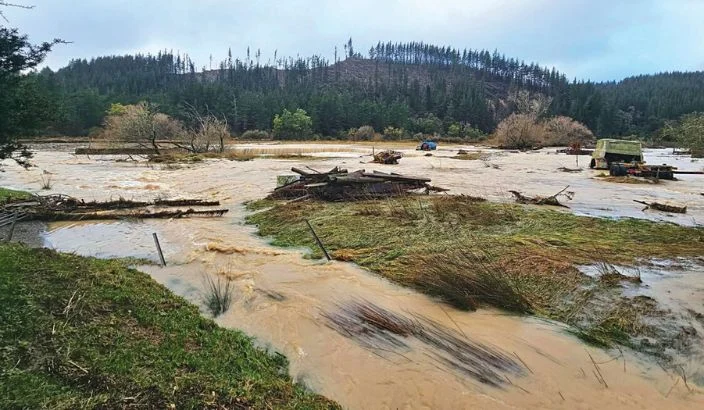
Tapawera farmer and grower Dave McGaveston says frustration over river management has been building for decades.
“It’s been getting progressively worse for the last 20 years,” Dave says. “Things started deteriorating when the old Catchment Board lost control. They had experience with the river and a common-sense approach. Since then, we’ve lost that local knowledge.”
Dave believes current rules under the Resource Management Act (RMA) and Tasman District Council have gone too far.
“We’ve ended up with a policy that says you can’t touch the river, and it’s getting fuller and fuller,” he says. “Environmentalists have infiltrated the council, clearly wishing to stamp out food production on flood plain areas – yet that’s where our most fertile soils are. At this rate, we might as well move to the hills.”
Recent rain exposed the problem, with rising waters eroding banks and leaving deep silt across farms.
“Some landowners ended up with half a metre of silt – we need a middle road and practical solutions,” Dave says.
He believes the council could do more despite RMA constraints.
“Back in 1877, during the ‘Old Man Flood,’ rivers would have been in this state – much like the council’s current approach – and the result was loss of life and devastation,” he says.
“Large floods will always spill onto floodplains, but it’s the smaller, regular ones that erode banks and do real damage, setting the stage for disasters like we saw in June and July.”
Dave says controlled gravel extraction could reduce flood risk, and sold gravel could fund maintenance.
“The recent floods were no bigger than the 1983 flood, but they’ve caused far more damage because the river hasn’t been properly looked after,” he says. “We need to go back to having local river boards – people with knowledge and a practical approach.”
While Dave acknowledges the RMA plays a part, he says council knowledge and attitudes have also changed.
“We can’t blame the RMA for everything,” he says. “We need to look at the type of people working in the environmental space within the council. Since 1990, when the council took control of our rivers, the maintenance of the fairway has been minimal and ineffective.”
Dave says a zig-zag flow pattern has developed, with water energy striking the banks and rebounding downstream, causing continual erosion. Rock has been added at pressure points where riparian vegetation has failed, but each flood shifts these points downstream – often by up to 50 metres – rendering the protection useless. Eroded vegetation and trees then block the fairway, slowing the flow and causing gravel and sediment to build up, forming beaches and islands that further restrict the channel.
A Tasman District Council spokesperson says it is focused on ensuring long-term resilience and protection for rivers and floodplains.
“While rivers are dynamic, constantly-changing systems, the June/July 2025 floods have pushed them into a new state, a new balance, that will continue to adjust and settle for some time. The long-term recovery work on our rivers will have this new dynamic state front of mind, and we will be looking to river management practices, old and new, including gravel extraction, that will prepare us for the next major flood as best as possible.”
Nelson/Tasman Federated Farmers president Kerry Irvine supports calls for more practical river management.
“Removing gravel from waterways isn’t an environmental disaster – it’s environmental management,” Kerry says.
He says Federated Farmers is pushing for changes to the RMA, which would allow for more local decision-making.
“When it comes to farmers working on rivers, the RMA comes into play because rivers are public natural resources, not private land. That complicates things.”
Kerry believes there’s a communication breakdown.
“River care management has been debatable. There’s a real breakdown currently between council, government and landowners,” he says. “Rivers need to be able to carry the capacity of water that they are being asked to hold. If the river’s capacity is being reduced due to built-up gravels, then the river’s capacity to hold water is reduced – making flooding more likely, spilling into nearby paddocks.”
“There is a lot of red tape around just getting consent to remove gravel and it’s becoming harder to manage rivers in a practical aspect, with a positive outcome,” Kerry adds.
The council spokesperson says collaboration with landowners remains an important part of identifying the needs and priorities of ongoing work.
Further south, Southland farmer Chris Dillon says the same issues are being felt across the country.
“The 2020 floods showed us what happens when gravel builds up – the erosion snowballs,” Chris says. “It’s not about mining rivers; it can simply be about moving gravel from side to side to help the channel work properly. That benefits everyone.”
Chris, who is involved in national discussions around RMA reform, says significant change is needed.
“We need timely decisions and a broader community view – not just the perspective of a minority group. Local knowledge should guide river management.”
For those feeling frustrated, his message is simple: “Keep at your council and local decision-makers – it’s poor decisions that have got us to this point.”
As farmers wait to see if practical RMA changes will eventuate, they remain in limbo – and the gravel keeps building.
