
ROBYN PARKES
By 1895, the old Māori church in Motueka was in a dilapidated state and too small for the congregation’s needs.
Efforts began to raise money for a new, larger church. With an estimated cost of £100 for building materials, much of the money was raised by local iwi through concerts and the sale of handcrafts.
One of the driving forces behind the project was Rev Fredrick Bennett, an Anglican priest who later became the first Māori bishop.
Within two years, most of the funds were secured and building began on land towards the hills, about half a mile from the Post Office.
The architect was T Roberts of the Nelson Public Works Office and the builder was Mr Miller of Nelson.
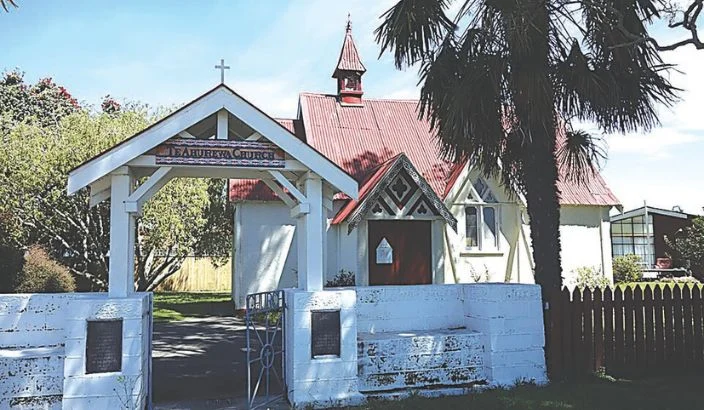
The church was designed in a cruciform shape, facing east to west, and large enough to seat about 60 people.
It was constructed of timber on concrete dwarf walls and roofed with iron at a moderate pitch.
An open bell turret topped the building, decorated with cut work and finished with a wrought iron scroll. Each point of the cross featured a gable, with a plain gilt cross at the west end.
Inside, the nave measured 27 by 18 feet and the chancel 12 by 8 feet. A choir stall, organ chamber and vestry completed the interior. The walls rose nine feet to the spring of the roof, which over the nave was open to the ridge, while the chancel was lined to form panel work. All windows were fitted with figured plate glass.
The church was named Te Ahurewa by Huta Paaka, a devoted supporter known for his influence in the Synod.
The opening ceremony took place on Sunday, 6 May 1897 at 11.45am, drawing people from across the Nelson district. A petition was read by Hemi Matenga on the porch, and the remainder of the service was held outdoors to accommodate the large crowd. Waiata, karakia and korero featured prominently, with Rev Bennett reading a lesson.
A hangi lunch followed, and entertainment was held that evening at the Motueka Institute building. Collections during the day and evening reduced the remaining £25 debt to £5.
Electric lighting was installed in May 1923 at a cost of £27, funded through parishioners’ efforts organising a concert.
Special services were held in August 1941 when Bishop Bennett planted three memorial trees – rimu, tōtara and English oak – in memory of Māori soldiers who fought in Greece and Crete.
In 1958, a memorial lych-gate was unveiled in Te Ahurewa’s grounds to honour Bennett and mark 100 years of friendship between Māori and Pākehā in the area.
Further restoration work took place between the late 1970s and 1990s. On 29 March 1997, the church celebrated its centenary, and the land was returned to Ngāti Rārua Te Ātiawa Iwi Trust.
